

Quick summary
- For an emotionally dependent person, a break-up is withdrawal: the craving is real, physical, mechanical.
- The traps of the first weeks: getting back in touch, idealising, replacing too fast.
- Grief in the dependency version is longer and non-linear, and that's normal.
- The break-up is the best window for work: the system is laid bare, therefore repairable.
- And if you can't leave even though you know, it's the same mechanism, in reverse.
The people around you seem to find it long. «You have to move on». Easy to say. They don't know what it's like to check your phone on waking for a message that won't come, to dial a number and hang up, to feel, physically, a craving that resembles a substance withdrawal to the point of confusion.
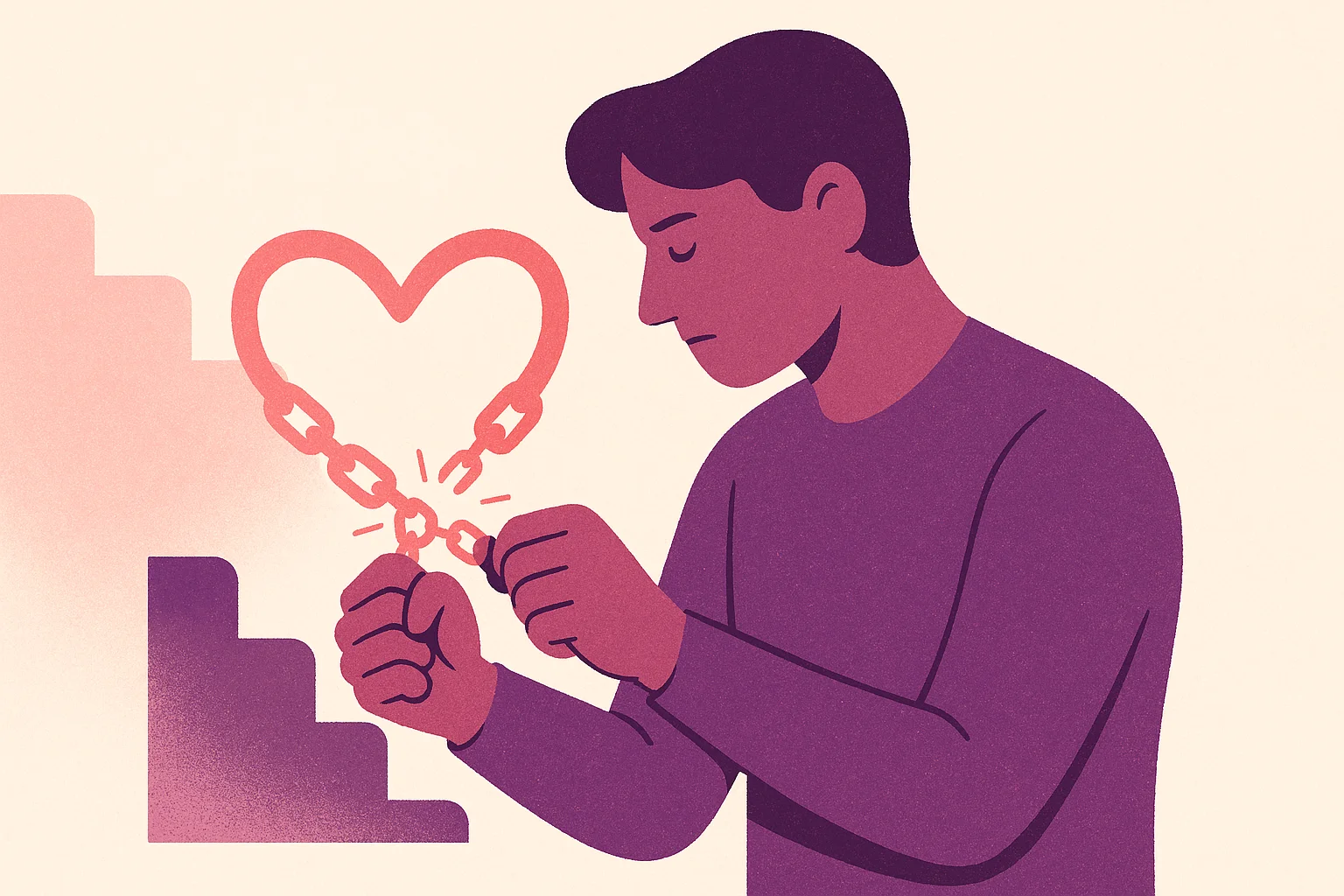
And let's talk about precisely that: for an emotionally dependent person, a break-up isn't ordinary heartbreak. It's withdrawal, in the literal sense. The other person was your emotional regulator, your source of worth, your anti-anxiety, and it all stopped at once. It's bound to be harder, and bound to take longer. That isn't weakness: it's mechanics.
But there's a reversal worth seeing: this break-up, precisely because it hurts so much, is also the best window for work you'll ever have. We're going to look at why it hurts so much, the traps of the first weeks, and how to turn this withdrawal into a lasting recovery.
Why it hurts so much (the mechanics of withdrawal)
Let's lay the mechanics out flat, because they change everything about how you look at your own suffering.
When your emotional balance rested on the other person's signals, their messages, their presence, their proof, your daily life ran as if on a drip. The break-up doesn't take away «someone you love»: it unplugs the drip. Hence symptoms that go beyond classic heartbreak: anxiety in physical waves, obsession (they occupy 90% of your thoughts), insomnia, loss of appetite, the impression of no longer knowing who you are without them.
That last point is the most important. Emotional dependency in love fuses identity with the relationship: «we» had replaced «I». So the break-up doesn't leave an emptiness IN your life, it leaves an emptiness INSTEAD OF your life. If you feel that, put a word on it and keep it: it isn't proof that they were irreplaceable, it's proof that the work to be done is in you, and that it's finally within reach.
| An ordinary break-up | A break-up when you're dependent | |
|---|---|---|
| What you lose | A person, a story | A person, and the way of feeling you exist |
| The sensation | Grief, in waves | Grief, plus a physical state of craving |
| The reflex | Talk, cry, take your mind off it | Get back in touch, watch, check |
| The duration | Decreasing, fairly steady | Jagged, longer, and that's normal |
The 5 traps of the first weeks
Withdrawal has its classic temptations, and it's better to know them before they hit, because they will hit.
- Getting in touch «just to know»: The innocuous message, the administrative pretext, the «I just wanted to see how you were». Call it by its name: a dose. The relief lasts an hour, and the withdrawal counter restarts at zero. Every contact lengthens the journey.
- Watching their traces: Their social media, their stories, their music, their online status. That's disguised contact, with the same effects. If you can't manage not to look, remove your means of looking: block, mute, hand over your phone in the evening. That isn't childish, it's well-managed withdrawal.
- Delayed idealisation: Your memory will sort, it's mechanical: the good memories rise, the bad ones fade, and after three weeks you won't remember WHY it's over. Antidote: write down now, today, the factual list of reasons. You don't reread it to ruminate, you reread it when your memory cheats.
- Replacing urgently: The temptation to fill the void with someone, anyone, right away. And it holds both ways: dependency follows its owner. A new sticking-plaster relationship is the same system with a new first name, and one more person damaged along the way.
- Measuring your recovery against theirs: They seem fine, they're already with someone, they're going out, and it destroys you. Remember: you have no idea what's happening behind their stories, and above all, their speed says NOTHING about your worth or your journey. You aren't running the same race. You never ran it against them at all.
Grief in the dependency version: longer, non-linear, and normal
Two things to know about the journey, so you don't get discouraged along the way.
It's longer than average, and that's structural: You aren't grieving a person: you're grieving a person PLUS the withdrawal from a regulation system. Two projects for the price of one. So when someone trots out the myth of «half the length of the relationship», smile and move on. Your journey will take the time it needs.
It isn't linear, and relapses into sadness aren't steps backwards. You'll be fine for ten days, then a song, an anniversary date, a rainy Sunday, and an enormous wave, like on day one. That's the normal functioning of grief, amplified by dependency: waves that space out and soften, not a steady slope. The only real indicator of progress is the trend over three months, never last night.
And to get through the waves you're already equipped without knowing it: the phase 1 tools from the dependency exit exercises, the 30-minute delay, the wave journal, the grounding, were designed for exactly these moments. They work even better after a break-up than in a relationship.
The reversal: the break-up as the best window for work
Now, the part nobody will tell you in the first days, but which is the truest: this break-up is the best chance for recovery life will ever hand you. Not despite the pain, but because of it.
In a relationship, emotional dependency is comfortably invisible: the drip is working, why touch it? It's now, laid bare, that the system becomes fully visible: the fear of abandonment, the outsourced self-esteem, the emptiness that terrifies. Everything's on the table, and everything visible can be worked on. People who do this work DURING a break-up, often with a therapist, because it's the right moment to be supported, come out with something the others never obtain: the lived certainty that they can survive the craving. That certainty changes every relationship that follows.
Concretely, the project is mapped out: the 12 exercises phase by phase, starting with stabilisation, and taking advantage of the fact that there's nobody left to sabotage the work. In six months you won't recognise your way of loving.
Measure your starting point, take it again in three months
The test assesses where your emotional dependency stands today, mid-crossing. Keep the result, and compare in three months. The difference between the two will be the one you built.
Take my starting snapshotFree · No sign-up · Instant result
And a word for the person reading all this from the other side of the mirror: you can't leave even though you know you should. It's the same mechanism, in reverse. The fear of withdrawal holds you exactly as it holds the other person after a break-up. The question of whether it's time to stay or leave the relationship then needs asking for real, knowing now that the craving waiting for you on the other side can be crossed. Thousands of people are crossing it right now. You'd be among the best prepared.
Read alsoHow to overcome emotional dependency: 12 concrete exercises, phase by phase
The Quiz Couple book
100 Adventures for Two
The book you fill in together: one adventure per page, and your memories inside.
See the bookThe perfect Christmas gift!