What is a soulmate?
Look up the definition and you will find everything and its opposite. Your star sign for some, "someone joyful and kind" for others, which describes roughly half the planet.
For us it is simpler. A soulmate is your other half of the pair: the person with whom being yourself takes no effort, with whom you agree on the fundamentals and not just on tastes, and with whom hard knocks bring you closer instead of breaking things.
Then comes the criterion everybody forgets, and it is the most important one: you have to stay whole. Being one, fine, as long as both of you still exist! When one of the two has vanished along the way, when the friends have drifted off and the personal plans have quietly been dropped, this is not a soulmate anymore. It is fusion, and the test tells them apart.
What a soulmate is not
Love at first sight
The intensity of the beginning predicts nothing. It only tells you how fast you got attached.
The perfect person
A soulmate has flaws, and some of them really do annoy you. The question is not whether they exist, but whether you can talk about them.
The one who completes you
The missing half makes for beautiful films. In real life, two whole people hold up better than two halves clinging to each other.
The different kinds of soulmate
We can tell several kinds of soulmate apart, and here are the 5 best known:
The romantic soulmate
The other half of the pair. The one you no longer play a part with, and who makes you more yourself instead of less. That is the one the test above measures.
The soulmate friend
Rarely talked about, and yet. A friendship can tick exactly the same boxes, with no romantic dimension at all. It is not a consolation prize!
The travelling companion
Solid, loyal, often long. But you still have to choose your words. Plenty of happy couples rest on exactly that, and it is no failure.
The twin flame
A mirror, not a shelter. The twin flame puts you face to face with what you were avoiding, with break-ups and returns. You do not come out of it the same person.
The karmic relationship
The same scene on a loop: the intensity stays, the exhaustion settles in, and leaving becomes impossible. That is not a soulmate: it is a karmic relationship, and it shows up through different signs than the four above.
Does it exist, or is it an invention?
The idea comes from Plato, in The Symposium. Humans were double beings, Zeus cut them in two, and ever since each of us has been looking for their half. It is a myth, told by a comic character, and it has travelled twenty-four centuries to end up in dating app bios. Twenty-four centuries later, what we mostly take from it are the lines we write on the back of cards, often crediting the wrong author.
So the real question is not "does it exist", but "what difference does believing in it make".
And there the research gets interesting, in particular the work of C. R. Knee. Two beliefs stand opposed. Destiny: people suit each other or they do not, and you can see it right away. Growth: a relationship is built, and difficulties are part of the job. The result is that destiny believers take the first real conflict badly, because it becomes proof they picked the wrong person. The others just see a problem to sort out.
In other words, looking for your soulmate can damage the relationship you already have. That is why this test measures no destiny at all: it looks at what your relationship makes of you, today.
The four pillars of the test
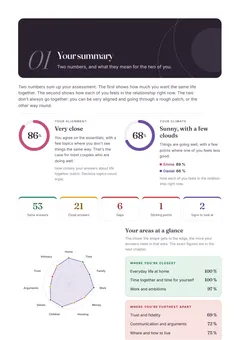
Every question belongs to one of these four pillars, and the test asks five per pillar. It is their balance that decides the result, not your total.
Ease
Can you be yourself, with no mask? Silences that do not weigh, words you do not need to weigh, the tired and unreasonable version of you the other person has already seen. This is not love at first sight, it is ease.
Deep agreement
Not the same tastes: the same values. How you treat a waiter, your relationship with money, what you consider loyal or not. You can love the same films and agree on nothing that matters.
Hardship
What difficulty has done to the bond. A loss, a hard blow, an argument you do not get over easily: did it bring you closer or crack you apart? A relationship never put to the test is not solid, it is new.
Autonomy
Your friends, your plans, your ability to spend a weekend apart. This is the pillar that does the most damage when it is missing: without it, ease is no longer ease, it is emotional dependency.
How to read your result
Your score is the average of the four pillars, with the weakest counted twice: a soulmate is not judged on their best side! The verdict does not come from a score band but from the shape of your profile. That is why a good score can produce something other than a flattering title.
| Your verdict | What it indicates | What you can do with it |
|---|---|---|
| Soulmates | All four pillars hold at once, autonomy included. That is rare. | Keep doing what got you there: see your friends, say things early, repair quickly. |
| Soulmates in the making | The ease and the agreement are there, but nothing has tested this bond yet. What you lack is time, not quality. | Watch how you repair small irritations. It is a good preview of what will happen at the first real shock. |
| Fusion, not a soulmate | The understanding is real, but you have shrunk. Friends, plans and the ability to be apart have all eroded. | Take back one single thing you had let go, and watch the reaction. It will teach you a lot. |
| Travelling companions | The fundamentals line up and you have supported each other, but you still have to watch what you say. | Look for where the restraint comes from. The fear of being judged sometimes falls away in one conversation. |
| Two paths crossing | Neither the ease, nor the deep agreement, nor the effect of hardship. Two good people can simply not suit each other. | The useful question is no longer "is this my soulmate" but "am I doing well in this relationship". |
This test is not a diagnosis and has no clinical value. It is a reading grid, to be set against what you already know.
Soulmate or fusion: the difference that counts
This is the most frequent confusion, and the most costly. Seen from the inside the two look very much alike: you understand each other without speaking, you want to be together all the time, the rest of the world drifts away.
The difference does not show in the intensity. It shows in what you have left on the side.
The signs of fusion
Your friends have disappeared
Rarely because of a ban. You declined, and then people stopped asking.
A day without news puts you in difficulty
That is no longer attachment, it is an alarm, and it says a lot about your attachment style. A solid bond can take silence.
The signs of a soulmate
You have kept your own life
Your friends, your plans, your wishes that do not include the other person still exist. And the other person takes them seriously.
You feel more like yourself
Not wiser, not smoother: more you. It is the most reliable sign, and the hardest to fake.
Absence does not cause panic
You miss them, which is very different. You get on with your day, and you have things to tell in the evening.
You have nothing about yourself to hide
The tired version, the unreasonable version, the frightened version: it has been seen, and nothing collapsed.
And if you are single?
If you are single, we are no longer trying to find out whether a bond exists with someone, but rather what kind of person could suit you.
And we are not talking about "someone kind, generous or funny", because that describes everyone and no one... Instead, we are going to work out how you function: what makes you feel loved, whether you are more gestures or words, how you react to conflict. That way you can get much closer to the kind of person who would suit you!
Frequently asked questions about soulmates
How do I know if this is really my soulmate?
Look at four things, not one. Are you yourself without effort? Do you agree on the fundamentals? Has difficulty brought you closer? And above all: have you kept your own life? The first three are found everywhere, the fourth is the one that settles it.
Can you have several soulmates?
Yes, and it is even the most likely. Nothing obliges you to believe in one single person among eight billion. A friendship can be a soulmate, and you can perfectly well live this kind of bond twice in a lifetime.
What is the difference between a soulmate and a twin flame?
A soulmate settles you, a twin flame transforms you. With a soulmate you feel rested and more available for the rest of your life. A twin flame puts you face to face with what you were avoiding, often with break-ups and returns. Both can be precious, but they do not cost the same.
Does the test work if we have only been together a short while?
Yes, and it will tell you so. A recent bond has not been tested yet, and the test spots it: it gives "soulmates in the making" rather than a title the first real difficulty would contradict.
Is this test reliable?
It is coherent, which is not the same. The questions are about observable facts rather than impressions, the verdict depends on the balance of your answers and not on a total, and no result claims to predict the future of your relationship.
The takeaway
A soulmate is not recognised by the intensity of the beginning, but by what you have left afterwards. After an argument, after a hardship, after three years.
The one sign that does not deceive is the one people look at least: does this relationship make you more yourself, or has it shrunk you? Everything else can be imitated by a beautiful story that will not last.
And if your relationship involves fear, control, humiliation or violence, no test has any say. Talk to a professional, or call the National Domestic Violence Hotline at 1-800-799-7233 (USA) or 0808 2000 247 (UK), free and confidential.