What is a crush?
A crush is a strong attraction to someone, often before you really know them. The word literally means "to squash": that's the idea of something falling on you. For example: you cross paths with someone at school or on Insta, and without quite knowing why, you start thinking about them all the time.
What defines a crush is that your imagination does a big part of the work. You barely know the person, so you fill the gaps with what you hope they are. That's why a crush feels so intense: you're not drawn to the real person, but to the best possible version of them.
And it's normal, everyone goes through it. A crush is neither ridiculous nor childish, and adults get them too. The real question, the one that probably brought you here, is whether yours is turning into something else.
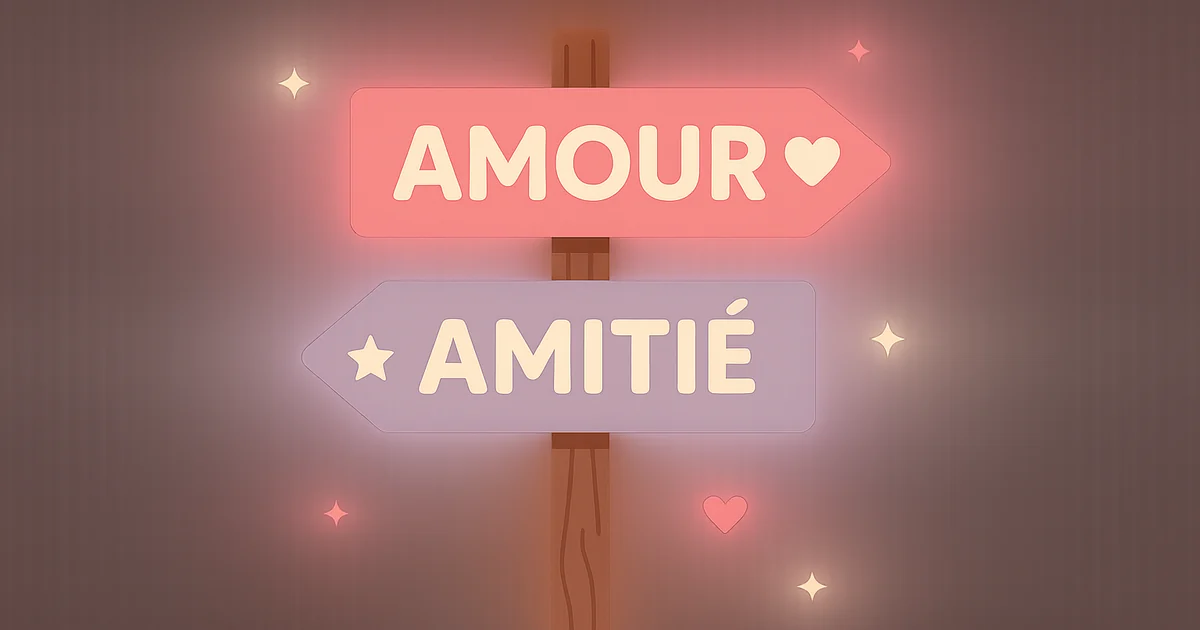
What separates love from a simple crush?
The main difference lies in what you know about the other person. A crush leans on what you imagine, love leans on what you know. In practice: if you've never talked to them for more than five minutes, what you feel is strong, but it rests on very little that's real.
The other difference is what it does to you. A crush is excitement: the racing heart, the tight stomach, the urge to see them. Love is attachment: missing them when they're not around, feeling in the right place with them, knowing their flaws and not caring. Here's how it plays out in situations you probably live:
| The situation | If it's a crush | If it's love |
|---|---|---|
| They don't reply | You stress out, you imagine a thousand things | You miss them, but you don't panic |
| You discover a flaw | You don't even see it, or you excuse it | You see it clearly, and it changes nothing |
| You talk for a long while | You weigh every sentence you send | It flows on its own, you stop calculating |
| They're away for a week | You think about it, but your life goes on | Something is missing from your days |
| Someone else catches your eye a little | Possible, a crush isn't exclusive | It doesn't happen anymore, and it surprises you |
| You picture what's next | Movie scenes: the first kiss, the looks | Concrete things: holidays, daily life, later on |
One warning though: nobody switches from one to the other overnight. Love almost always starts as a crush, and a crush that lasts, that survives flaws and absence, is often the beginning of real feelings. That's exactly what the test measures: where you are on that path.
How do you know you have a crush on someone
Most of the time, you know before you admit it. The body speaks first, and it can't lie. If you recognise three or four of the signs below, the question is already settled:
The signs that don't lie
- You think about them without deciding to: in class, on the bus, at night. They show up in your head on their own, several times a day.
- Your phone becomes an extension of your crush: you open their stories first, you reread your conversations, you type messages you never send.
- Your body reacts to their presence: the knotted stomach before seeing them, the warm cheeks when someone says their name, the racing heart when their name pops up.
- You change your habits to cross their path: a detour in the hallway, a party you attend because they'll be there, an outfit chosen with them in mind.
- Your eyes find them on their own: in a crowded room, you always know where they are, without ever deciding to look.
- Your friends know despite you: either because you talk about it too much, or because it's written on your face.
If you tick almost everything, the question is no longer whether you have a crush. It's whether it's still a crush, or already more. That's where the test's 35 questions do the sorting, weighing each sign: thinking about someone every day weighs more than having had shivers once.
How do you know if they like you back?
Start by looking at who starts the conversations. If it's always you texting first and their replies are polite but short, you have part of your answer. If they follow up, ask about you, bring back things you said a week ago, it means they keep what you say somewhere.
Then look at what they do with their nerves and their attention when you're together. Someone who likes you looks for you, finds excuses to talk to you, stays around when the group scatters. With a guy, the hands, the mouth and the eyes give the nerves away long before words do. And if you want a steadier answer than a hunch, we have a dedicated test that reads how they behave when they don't know you're watching.
One last tip: don't draw conclusions from a single gesture. A story viewed, a like, a smile means nothing on its own. It's repetition that talks: someone who seeks you out once may be polite, someone who seeks you out every week has a reason.
My crush feels out of reach and it makes me sad: what should I do?
First, know that this is the most common situation there is. The unreachable crush, the one who's older, already taken, super popular or who doesn't even know you exist, almost everyone has had one. The sadness that comes with it is real, it's not drama, and you're allowed to feel it.
Then be honest about one thing: are they out of reach for real, or in your head? There's a big difference between someone in a relationship, where there's nothing to try, and someone you've just never dared to approach. The second case isn't unreachable, it's fear, and fear can be worked on.
What helps, in order
- Put a real word on the situation: "taken" is not "shy", and "they don't know me" is not "they rejected me". Half the sadness comes from mixing all of it up.
- If it's fear, start small: no declaration, just a conversation. A question about a class, a reply to a story. We've even put together questions to ask your crush to get things going without it being weird.
- If it's a real wall, cut what feeds the crush: stop watching their stories every day. A crush feeds on images, and you're the one holding the spoon.
- Give yourself a deadline: not for your feelings, you don't command those, but for your decision. "In a month, either I've talked to them, or I move on." It keeps a sadness from dragging on for a year.
And keep one thing in mind: a crush that leads nowhere is not wasted time. It teaches you what attracts you, what moves you, what you'll want to find in someone within reach. The next person will benefit.
The questions everyone asks
How long does a crush last?
A few weeks to a few months, most of the time. A crush feeds on novelty and mystery: as soon as you know the person better, it either fades or turns into something more solid. Past six months without weakening, it's probably no longer a simple crush.
Can you have a crush while in a relationship?
Yes, and it doesn't make you a cheater. A crush is a reaction, not a decision. It all hangs on what you do with it: let it pass, or feed it in secret.
Crush or love: can the test be wrong?
The test measures what you're living, based on what you answer. If you answer what you truly feel, the score is reliable on the trend. But no test reads your mind: it helps you see clearly, it doesn't decide for you.
Why does my crush obsess me so much?
Because a crush leans on uncertainty. Your brain loves unanswered questions, and "do they like me?" is a huge one. That's why a crush takes up more space than a settled relationship: it's not the person that obsesses you, it's the suspense.
How do you get over a crush?
Cut what feeds it: the stories, the account you keep checking, the detours to cross their path. Without new images, a crush fades within a few weeks. It works, provided you actually do it.
Is it bad to have a crush on someone I don't know?
No, it's even the most classic form. But keep in mind you're falling for the image, not the person. The only way to know what's behind it is to talk to them.
Does the test work if my crush is a girl and so am I?
Yes. The test only asks whether your crush is a guy or a girl, to write the questions correctly. Who you are changes nothing about the questions or the score.
Take the test, you'll know in five minutes
35 questions, no sign-up, and nobody but you sees the result. Answer what's true, not what suits you: the test is useless if you tell it what you want to hear.
And if the score says "real feelings", take a breath. It doesn't oblige you to anything, it just tells you where you stand.