The mental load is not doing the dishes
This is the misunderstanding that blocks every conversation on the subject. When a couple argues about the division of labour, one of them is talking about execution and the other about anticipation. They are not discussing the same thing, and neither of them realises it.
The mental load is not taking the bins out. It is knowing that it is bin day. It is not buying toothpaste, it is noticing that it is about to run out. It is not driving someone to the doctor, it is remembering to book the appointment three weeks earlier. Visible work is seen by everyone. Invisible work is seen by nobody, except the person doing it.
That is why « you only have to ask » is the heart of the problem rather than its solution. Asking requires knowing what needs doing, knowing when, and remembering to say so at the right moment. Whoever has to ask keeps the entire load and delegates only the execution, which is the lighter half.
So this test measures anticipation and nothing else. On each of the twenty tasks, the question asked is never « who does it », it is « who thinks about it ».
The four areas where the load settles
It is almost never imbalanced everywhere in the same way. The test splits it into four areas, because seeing where it tips is more useful than a single overall figure.
A simple way to tell the two loads apart: imagine you left for ten days without warning. Whatever would stop working is your mental load. Whatever someone else would do in your place without thinking about it is execution.
What your result means
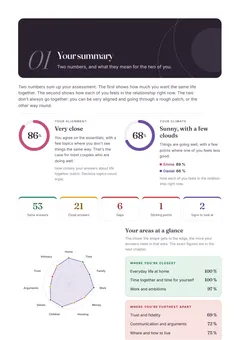
The test first gives a split as a percentage, then the breakdown by area. In two-player mode it adds the measure that makes this page worth reading: the gap between your two sets of answers. An imbalance both of you see and an imbalance only one of you sees are not handled the same way. The four situations below are the two-player ones, the only ones where that gap can be measured.
| Situation | What it describes | What to do about it |
|---|---|---|
| You are a team | Evenly split, and you describe the same thing. | Nothing to fix. Retake the test after the next big change. |
| Split, but blurry | The total is balanced, your two versions diverge. | Describe to each other what you actually do. Resentment comes from the misunderstanding. |
| Acknowledged imbalance | One carries more, and you agree on that. | The question is not whether it is fair, but whether it holds. Set a date. |
| One carries, the other cannot see | The most common case, and the costliest over time. | Start from the three disagreements the test gives you, not from a list of grievances. |
On your own the gap cannot be measured, so the test returns one of two results instead: « You are describing a shared load » or « You are describing a load resting mainly on one person ». The word that matters is describing. The split is precisely the point on which the two members of a couple diverge most, so a solo result mainly says where you stand, not where the two of you stand.
Why it almost always lands on the same person
No couple decides one day that one of them will handle everything invisible. The imbalance is not decided, it settles, and it does so through mechanisms that are fairly simple to name.
Whoever notices first ends up handling it
This is the main mechanism, and it has nothing to do with goodwill. Two people have different tolerance thresholds for mess, empty cupboards or overdue appointments. The one with the lower threshold sees the problem first, deals with it, and becomes by default the one who always deals with it. Within a few months, the other has stopped looking.
Expertise becomes a trap
As soon as one person does something twice as well or twice as fast, it becomes rational to leave it to them. Except that efficiency has a price: every task assigned on competence becomes a task nobody else will know how to pick up, and the area closes over.
Helping gets mistaken for sharing
« I help you » and « I handle it » are two very different positions, and many couples do not measure the distance between them. Helping means executing on request, which leaves the other person the job of knowing, planning and reminding. A couple where one helps a great deal can have an almost equal split of execution and a completely lopsided mental load.
Nobody is counting the same things
Each person has a precise view of what they carry and an approximate view of what the other carries. That is not bad faith, it is how attention normally works: you see what you do, and you do not see what got done without you. That gap is exactly what the two-player mode measures.
None of these four mechanisms requires any ill will. That is what makes them hard to correct: there is nobody to blame, and the situation is nonetheless entirely real.
What it costs when it lasts
An unbalanced mental load does not cause a crisis. It produces wear, and wear is only noticed once it has already done its work.
The first effect is a tiredness that sleep does not repair, because it comes from continuous mental activity rather than physical effort. The second is resentment, which accumulates slowly and generally comes out over something tiny, which makes it incomprehensible to the other person: the argument is about a sock, never about the substance.
The third effect is the hardest to undo. By managing everything, a person ends up occupying the position of organiser within their own relationship, and that position comes with a role that is not remotely romantic. Many couples describe this shift without being able to name it: you have stopped being two adults living together, one directs and the other executes.
If you recognise yourself in those three paragraphs, the good news is that the mental load is one of the few imbalances that gets corrected with organisation rather than with a change of personality.
What rebalances things, and what does nothing
Many of the solutions offered on this subject move nothing at all, because they leave the invisible half exactly where it was. Here is what works, and what merely creates the impression of acting.
Transfer a whole area, not tasks
This is the only transfer that genuinely lightens the load. « You handle the medical appointments » means knowing when they are due, booking the slots, noting them and sticking to them, with no reminders. As long as somebody has to remind, the load has not moved an inch.
Accept that it will be done differently
This is where most rebalancing attempts fail. A transferred area will be run differently, often worse at first, sometimes worse for good. Taking it back at the first mistake returns everything to square one and permanently installs the idea that the other one cannot manage it.
Write the list once, together
Many invisible tasks only exist for one of the two at the moment they see them written down. Taking the inventory together, once, changes more than a conversation about fairness, because it replaces a debate about impressions with an object both of you can look at.
What does not work
Rotas pinned to the fridge last about three weeks. Shared task apps shift the load onto whoever fills in the app. And « just tell me what to do » is, quite literally, a request to keep hold of the mental load.
How to raise it without it going badly
This conversation derails often, because it is nearly always opened at the wrong moment: on a tired evening, after a final straw, in the form of a reproach. The person on the receiving end hears an accusation, defends themselves, and the substance never gets discussed.
That is precisely what the test is for. It replaces « you never do anything » with a neutral object you both look at, and it points to three specific tasks rather than a general trial. Three tasks can be discussed. A trial cannot.
If you are the one discovering the imbalance while reading the result, there is only one useful thing to do, and it is not to justify yourself. Ask the other person to walk you through a typical day of what they are holding in their head. It is the fastest way to understand, because it makes visible what by definition cannot be seen.
Come back to it once the subject has cooled, with a date set in advance to take stock. A rebalancing rarely holds if it is only checked at the next crisis.