

Quick summary
- The real question is not "do I love them" but "do I still like who I am when I am with them".
- Eleven signs point to a dead end: contempt, fear, isolation and the disappearance of repair are the most decisive.
- Seven signs say it is worth continuing, the most reliable being that you still argue for real.
- A rough patch has an identifiable cause and a start date. A dead end does not.
- Boredom, routine and falling desire are not grounds for a breakup in themselves: they are symptoms, and they can be treated.
- If violence, fear or coercive control are part of the picture, the question is no longer "stay or go" but "how do I leave safely".
If you want the short answer, here it is: you end it when the relationship asks you to give up who you are, and you stay when it only asks you to work at it. Everything else in this article exists to help you work out which of the two you are in.
Because nobody asks this question on a Tuesday morning out of curiosity. By the time it arrives, it has been around a long while. You have thought about it in the shower, in the car, watching your partner sleep… You may even have opened this article hoping someone would give you permission to leave. Or permission to stay?
I am not going to do that. Nobody on the outside can decide for you, and be wary of anyone who claims otherwise in eight bullet points. What does exist are signals that come back again and again, in the couples who separated as much as in the ones who held on. Knowing them will not decide for you, but it will stop you circling the same question for another two years.
What separates a relationship worth saving from one that is over
A relationship deserves to continue when it is going through a difficulty that has a name: a bereavement, a move, burnout, a new baby, a betrayal you are actively repairing. The couple is suffering, but it is suffering from something.
A relationship deserves to end when the difficulty is the relationship itself. When you cannot name what is wrong because what is wrong is everything, permanently, for so long that you no longer remember what before looked like.
Between the two lies an enormous grey zone… and that is where most people asking this question live. The rest of this article is about getting out of it.
The 11 signs that say it is time to stop
None of these signs is enough on its own! What counts is how they accumulate, and above all how long they last. A month of contempt inside a hard year is not the same thing as three years of ordinary contempt…
Contempt has replaced anger: this is the most documented signal in couples research, and the worst one. Anger says "you matter enough for me to fight". Contempt says "you are no longer worth it". The eye roll, the small laugh, the mocking imitation: these are not details, they are the poison.
Nobody repairs any more: in a couple that holds, someone comes back after the argument. A hand on a shoulder, a joke, a coffee handed over without a word. When those gestures disappear and every argument ends with two people in two rooms, the bond stops being stitched back together.
You monitor yourself: you weigh your sentences before speaking. You read the mood in advance. You tidy up before they get home to avoid the comment. That is not tact, it is fear, and fear has no place in a relationship.
Your friends have gone: not all at once: one by one, each for a good reason. That one was "odd", this one "wound you up". Gradual isolation is one of the most recognisable markers of a relationship that has turned toxic, and it is also the one you see least from the inside.
You lie about things that do not matter: the price of a jumper. Having had lunch with a colleague. When lying becomes easier than telling the truth about trivia, it is because the truth costs too much.
Respect has left the arguments: you can argue loudly and stay decent. The day insults arrive, the day what your partner confided as their most fragile thing gets used as a weapon, a line has been crossed.
You picture your life without them, and you breathe out: not the revenge fantasy, not the anger. That calm image of a flat of your own, a Sunday of your own. If it comes back often and it soothes you, it is telling you something.
The plans have stopped: you no longer talk about next summer. You no longer buy anything together that lasts more than two years. A couple with a future mentions it without thinking; a couple without one avoids the subject without saying so.
You stay for reasons that are not the person: the rent, the children, what people would say, the fear of starting again at forty. These are real reasons and they weigh a lot. But none of them is about your partner.
You have already said everything, several times, and nothing moved: not one difficult conversation: ten. The same one. With the same promises and the same return to the starting point three weeks later.
You do not recognise yourself: you have become someone smaller, more careful, less funny. People close to you have said it and you defended your partner. This is the signal that sums up all the others.
If you ticked more than six lines… the question is probably no longer whether to stop, but why you have not done it yet. And that is a different question, often a much harder one.
The 7 signs that it is worth staying
They are far less dramatic than the previous ones. Which is exactly why they get forgotten when things are bad…
You still argue for real: counter-intuitive but solid: arguing takes energy, and we only spend it on what matters. The opposite of a couple that holds is not a couple that shouts, it is a couple that has stopped saying anything.
Simple moments survive: an unplanned burst of laughter, a series watched without touching but comfortably. These are not crumbs: they are proof that the bond still works when the pressure drops.
You can name the problem: "Since he changed jobs." "Since the miscarriage." A problem with a start date usually has a way out.
Your partner is worried too: two people wondering whether it will hold are two people who want it to. The worst case is the one where one of you is struggling and the other shrugs.
You still admire something about them: how they are with their parents, their courage at work, their patience. Love can fall asleep; admiration much less so.
What is missing is time and attention, not willingness: plenty of couples are not dying: they are tired, and they stopped asking each other anything beyond logistics about two years ago.
You still picture a future, however vaguely: a trip, a flat, a dog. If the future still contains two people, it is not over.
Rough patch or dead end: how to tell them apart
This is the distinction that matters most, and the one most often missed, because both hurt in the same way.
| Rough patch | Dead end | |
|---|---|---|
| Origin | An identifiable event | Impossible to date |
| What hurts | The situation | The person, or yourself inside the relationship |
| The arguments | About a specific subject | Always the same one, under different pretexts |
| After the argument | Someone comes back | You each move a little further away |
| When things improve | You find each other again | You cohabit more calmly |
| The idea of leaving | Frightens you | Relieves you |
The best test fits in one sentence: imagine the current problem vanishes tomorrow morning, with a wave of a wand. Work calms down, money comes in, the mother-in-law goes quiet. Are you happy with this person?
If the answer is yes, you are going through something. If the answer is "I do not know"… or worse, "no, but at least it would be simpler", then the problem was never the problem.
A hunch is not enough to answer that question. A questionnaire that weighs each sign of an ending by how serious it is gives you a result that is harder to wave away than the memory of your last argument.
What is not grounds for a breakup, despite what people think
A good share of people who separate do so over things that can be repaired. Not all of them, far from it. But these come up so often they deserve naming.
Falling desire: after a few years, spontaneous desire gives way to responsive desire: it no longer arrives on its own, it arrives when you create the conditions. That is not a breakdown, it is a change of mechanics, and many couples separate believing it is irreversible.
The feeling of being flatmates: it is real and it hurts. But the line between staying out of love and staying out of habit is blurrier than it looks: habit is sometimes love that stopped saying itself out loud, and that can be restarted.
Frequent arguments: what predicts separation is not how often you fight, it is what the fights contain and how they end. People who argue three times a week and repair do better than people who never argue and avoid each other.
No longer telling each other everything: nobody tells everything. The problem starts when what goes unsaid is precisely what matters.
That said, if silence has settled everywhere and no conversation reaches a conclusion any more, it is no longer discretion: something structural has broken, and it does not fix itself.
This can be repaired
- Routine and boredom, when both of you complain about them. That is two people who still want something else.
- Desire that has dropped over a few years, with no reproach behind it.
- Frequent arguments that actually end, with someone coming back afterwards.
- A crisis with a date on it: a bereavement, a move, burnout, a new baby.
This does not repair itself
- Ordinary contempt, the kind nobody even notices any more.
- Fear, in all its forms, including the polite version.
- Isolation, when your friends went quiet one by one.
- The same subject raised ten times, with the same promises and zero change.
When the question stops being the right one
There are situations where "stay or go" is the wrong frame, and where thinking in couple terms is actively dangerous.
If there is physical violence, to any degree, even once. That is not a relationship problem, it is a crime, and the question becomes your safety.
If there is fear: not the apprehension of a difficult conversation: fear. If you adapt your behaviour to avoid triggering a reaction, you are no longer living in a relationship, you are managing a risk.
If there is coercive control: it advances in disguise: it starts as excessive attention, continues as jealousy presented as love, and ends as control over money, clothes and people. The mechanisms of narcissistic control are specific enough to be recognised, and recognising them is often the first step.
How to decide without lying to yourself
Once the signals are laid out, you still have to choose. Here is what actually works… and none of it is spectacular.
Give yourself a deadline: not "we will see". A date. Three months, six months. A decision without a deadline is not a decision, it is a wait, and waiting wears you down more than leaving.
Decide what you are testing: during those three months, what actually changes? Therapy, two evenings a week without phones, one conversation every Sunday. If nothing changes, you are testing nothing: you are waiting for it to pass.
Write it down: on a bad day you only remember the bad; on a good day you erase all of it. Three lines each evening for a month give a far truer picture than your memory does.
Talk to someone who does not love you too much: your best friends will tell you what you want to hear. A therapist, a slightly blunt sibling, anyone without a stake in the story will be more useful.
And if you do not know how to open the conversation, the simplest route is a questionnaire you each fill in separately before talking. Answering apart and then comparing defuses a lot: it stops being you against them and becomes the two of you facing a measured gap. There is a questionnaire you fill in as a pair that compares your answers, and another that measures more precisely what makes a relationship healthy.
When the question is heavier and the word separation is already on the table, there is also a questionnaire built around the decision to divorce, with result bands written for that specific moment.
If you decide to stay
Staying is not doing nothing. It is the opposite, and it is exactly why so many couples who "decide to stay" separate eighteen months later: they decided to remain, not to change.
Staying means naming one thing to repair and sticking to it. Just one! Most couples fail because they try to overhaul everything at once, and three weeks in, tiredness wins.
It also means accepting that the relationship afterwards will not look like the one before. You do not go back to the beginning. You build something else, with people who have changed. The couples who make it are not the ones who recover their old relationship, they are the ones who accept a new one.
And if you decide to end it: that is not a failure. A relationship that ends is not a relationship that went wrong. It lasted as long as it had to, and you were someone for someone during that time.
The questions people ask at this point
How long should I give it before deciding?
Three to six months, with a concrete change put in place from the start. Under three months you are measuring a mood. Beyond a year with nothing moving, you are not waiting for a decision, you are avoiding one.
Can you love someone and still have to leave them?
Yes, and it is the most common situation among people who hesitate for a long time. Love has never been enough to make a relationship liveable. The useful question is not "do I love them", it is "do I still like who I am when I am with them".
Should I tell my partner while I am still unsure?
In most cases yes, but not as "I am wondering whether to leave you". Rather: "I have not been alright for a while and I want us to talk about it". The first sentence triggers a crisis, the second opens a conversation.
What if I am the problem?
That is an honest question and it deserves better than a reassuring answer. How we react to conflict and distance is largely shaped by our attachment style, which can be observed and worked on. Plenty of people replay the same script from relationship to relationship without seeing it.
Are children a reason to stay?
They are a reason to do things properly, not necessarily to stay. The research is fairly consistent: what damages children is not the separation itself, it is the conflict they witness, before and after.
The one question only you can answer
There is no threshold beyond which you must leave. No score, no percentage, and certainly not in an article. What exists are signals, and one question only you can answer honestly: am I going through something, or am I settling into it?
Most people already know the answer when they arrive here… What they are looking for is someone to confirm it. If that is you, take this as the confirmation.
Relationship assessment -20% right now
The complete assessment of your relationship
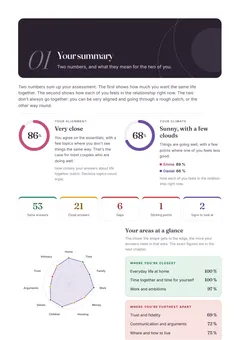
About a hundred specific questions on money, children, where to live, fidelity... Each of you answers on your own side, or you answer alone if the other isn't ready, and you get a 40-page report that compares the answers, topic by topic.
- 100 questions, together or on your own
- Built on research in couple psychology
- A 40-page PDF report, with charts
Free questions · report Usual price: €9.90 Discounted price: €7.92 for both of you