Jealousy Test • Free • 5 min

Couple jealousy test: are you jealous?

Two tests to measure jealousy in your relationship: your own and your partner's. Nuanced results.

Jealousy in a relationship is rarely black and white. There's the kind that reassures because it says you care about the other person, and then there's the kind that suffocates, that watches, that ends up damaging everything. In between there's a whole range of behaviours we don't always see clearly when we're in the middle of it.

This page offers two distinct tests. The first is for those who are questioning themselves. The second is for those whose partner is the concern. The results aren't diagnoses. They're a starting point for reflection, alone or together.

Am I jealous? Personal jealousy test

Answer spontaneously. Your first reaction is what counts.

Questions preview

Here is a preview of the questions covered. Start the quiz above to get your personalized result.

  1. Your partner comes home later than expected without warning you.

    • I ask if everything's okay and we move on.
    • I worry a little but it passes quickly.
    • I start imagining scenarios and find it hard to switch off.
    • I send several messages, check their social media, can't sleep.
  2. Your partner bursts out laughing on the phone in another room.

    • I don't pay it any mind.
    • I vaguely wonder who they're talking to, but that's it.
    • I listen in and wait for them to hang up to ask questions.
    • I feel physical tension and want to know immediately who it is.
  3. Your partner mentions a coworker you don't know.

    • No particular reaction.
    • I mentally note the name but it doesn't bother me.
    • I quietly look this coworker up on social media.
    • I question my partner in detail and bring it up again several times.
  4. Your partner spends an evening with their friends without you.

    • Great, I enjoy some time to myself.
    • I miss them a little but it's perfectly normal.
    • I wait for their messages and find it hard to focus on anything else.
    • I send frequent messages checking where they are and who they're with.
  5. You see a photo of your partner with an ex on their social media, posted before you.

    • It doesn't bother me, that was before me.
    • I look at it with curiosity but without any unease.
    • I compare myself to this person and it occupies my thoughts for a while.
    • I ask my partner to delete it or it leads to an argument.
  6. Your partner tells you a friend complimented their appearance.

    • I'm happy for them.
    • I file it vaguely but it doesn't really affect me.
    • I ask questions about this person and want to know more.
    • I feel a pang of irritation and the episode stays with me.
  7. Your partner takes a while to reply to your messages.

    • I assume they're busy and think about something else.
    • I notice the delay but don't make it a problem.
    • I start wondering what they're doing and why they haven't replied.
    • I send a second message, maybe a third, and analyse their reply when it comes.
  8. Your partner regularly works with someone you find attractive.

    • It doesn't affect my trust at all.
    • I note it without it really bothering me.
    • I think about it from time to time and it generates mild anxiety.
    • I look into this person and question my partner about them.
  9. You walk past your partner's unlocked phone.

    • I don't even glance at it.
    • My eyes pass over it but I don't intentionally read anything.
    • I notice what's on screen without really looking.
    • I feel the urge to read their messages and I've done it before.
  10. Your partner cancels your plans at the last minute with a vague reason.

    • I'm disappointed but I accept it without drama.
    • I ask a few questions, it disappoints me but I move on.
    • The vague reason worries me and I try to find out more.
    • I assume the worst and struggle to let it go without a long conversation.
  11. A friend tells you they saw your partner somewhere you didn't expect.

    • I'll ask them about it, no rush.
    • I'm surprised but wait to speak to them directly.
    • I try to piece together their day before talking to them.
    • I call them immediately for an explanation.
  12. Your partner tells you they had dinner with a friend you don't know.

    • No problem.
    • I wonder who it is but it stays light.
    • I want to know more about this person and the context.
    • I feel uncomfortable and would have preferred to know in advance.
  13. You imagine your partner meeting someone attractive on a work trip.

    • That kind of scenario doesn't cross my mind.
    • It crosses my mind for a second then disappears.
    • I think about it more than I'd like to.
    • This kind of situation genuinely causes me anxiety.
  14. Your partner tells you they've kept in touch with an ex.

    • OK, as long as it stays transparent.
    • I take note with mild reservations but accept it.
    • I want to understand the nature of the contact and how often they speak.
    • I feel deeply uncomfortable and struggle to accept it.
  15. You look at who your partner follows on Instagram.

    • I never look out of that kind of curiosity.
    • I may have looked once, without really searching.
    • I sometimes check, especially when something has put me on edge.
    • I regularly monitor their new followers.
  16. Your partner is particularly cheerful and in a good mood for no apparent reason.

    • It makes me happy.
    • I'm glad about it even if I vaguely wonder why.
    • The question "why this mood?" settles in my head.
    • I try to understand the origin of this mood and it can worry me.
  17. You notice your partner seems distracted during a dinner alone together.

    • I ask if something's on their mind.
    • I notice, mention it, and we move on.
    • I wonder if it's because of someone and it slightly spoils the moment.
    • I feel hurt and imagine someone else is on their mind.
  18. A stranger openly flirts with your partner in front of you.

    • It doesn't affect me, I'm confident.
    • I'm mildly annoyed but that's where it ends.
    • I closely watch my partner's reaction.
    • I feel a rush of adrenaline and struggle to stay calm.
  19. Your partner spends a long time getting ready before going out without you.

    • I enjoy watching them, I'm proud.
    • I notice they're making an effort without reading anything into it.
    • I wonder who they're making the effort for.
    • I ask them directly or it clearly affects me.
  20. Looking honestly at your behaviour, you recognise yourself in this description:

    • "I trust my partner and I don't try to control."
    • "I sometimes have doubts but they pass without me acting on them."
    • "I sometimes monitor or look for proof, even if I'm not proud of it."
    • "My worry about my partner takes up a lot of space in my head."

Why do we feel jealousy in a relationship?

Jealousy doesn't appear out of nowhere. It settles where there's something to lose, which means that in many cases, it first says that you care about the other person. Except that's not the whole story.

Most relational jealousy draws from two main sources. The first is fear of abandonment, often inherited from past experiences, a relationship that ended badly, an old betrayal, sometimes something far older than the current relationship. The second is a lack of self-confidence. Not a lack of trust in the other person, but in yourself. "Why would they stay with me if someone better comes along?" That question, not always conscious, feeds a lot of reactions we wrongly attribute to the other person.

There's also a third factor that gets mentioned less: attachment style. People with what's called anxious attachment, roughly a third of the adult population according to developmental psychology research, have a heightened sensitivity to signals of distance and more easily interpret neutral situations as threats. It's not a flaw, it's an emotional wiring that set in early and can be worked on.
Is jealousy in a relationship a problem?

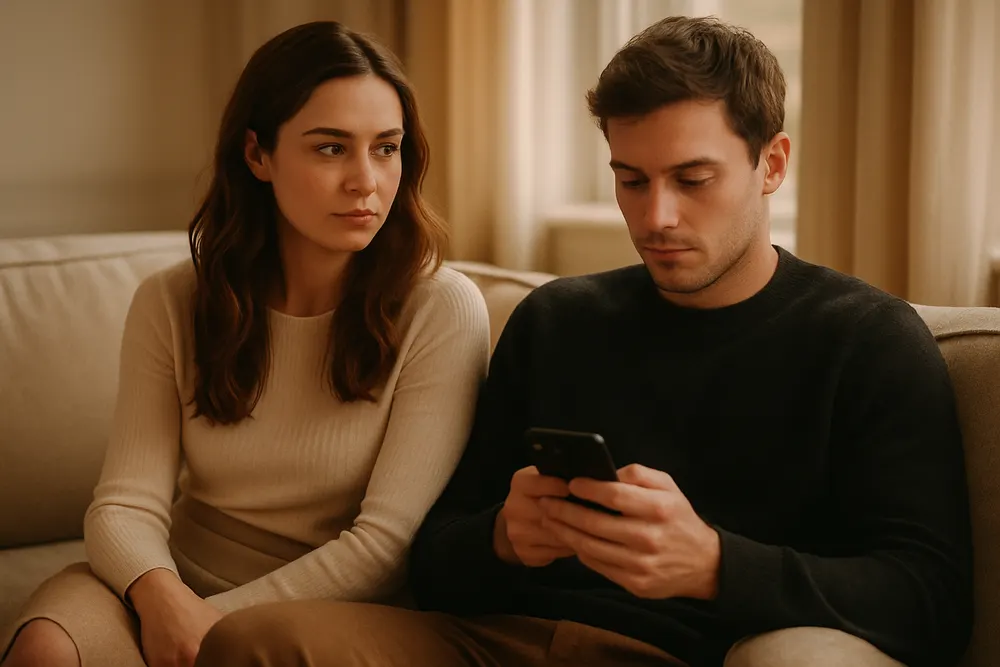
The short answer: it depends on its intensity and the behaviours it produces.

A mild jealousy, the kind that shows up as a twinge when someone flirts with your partner or a slight anxiety when they come home late without warning, isn't a problem in itself. It stays within the bounds of what's human.

  • Jealousy remains healthy as long as it doesn't lead to controlling or monitoring behaviours. It's an emotion that says you care about your partner.
  • Jealousy becomes problematic when it starts dictating behaviours: checking the phone, monitoring movements, systematic questioning, restricting the other person's social life.

We move from a normal emotion to a mode of control that damages trust and personal space. The jealous person suffers, the monitored person suffocates. Both lose.

How to interpret your score?

Each test is scored out of 60 points (20 questions × 3 points max). Here are the result levels:

ScoreJealousy levelInterpretation
0 to 12 pointsLittle to no jealousyJealousy doesn't seem to be an issue in your relationship. Solid foundation of trust.
13 to 36 pointsMild to moderate jealousyJealous reflexes exist but remain manageable. A good starting point for reflection.
37 to 60 pointsSignificant to intense jealousyJealousy takes up significant space. It's important to talk about it and seek help.

How to stop being jealous in a relationship?

The first step is to understand where the jealousy comes from. Not in general theory, but in your specific case. Has it always been there or did it appear at a particular point in this relationship?

Here's what concretely helps:

Work on self-confidence

Jealousy that comes from feeling "not good enough" doesn't resolve itself by monitoring the other person more, it resolves by rebuilding self-esteem. Therapy, fulfilling activities, a social circle outside the couple.

Name what you feel

"When you come home late without warning, I feel anxious" says something different from "you couldn't care less about me". The first opens a conversation, the second closes one.

Distinguish fact from interpretation

Your partner laughed on the phone, that's a fact. "They were laughing with someone they fancy" is an interpretation. The space between the two is where jealousy lives. Shrinking that space is a skill that can be learned.

My partner is too jealous: what should I do?

Living with a very jealous person is exhausting in a specific way. Because you're not doing anything wrong, but you still have to account for it.

Don't confuse love and jealousy

Excessive jealousy isn't proof of love, it's a signal that something isn't right in them, and that it's spilling onto you. That distinction changes how you approach the situation.

Talk about it directly

Outside of a conflict context. "When you check where I am several times a day, I feel monitored and it weighs on me" is an opening that lets the other person hear something concrete.

Set clear boundaries

If jealous behaviours persist, intensify or start to look like control or isolation, that's a limit worth setting clearly. Loving someone doesn't mean accepting living under surveillance.

Recognise warning signs

You regularly modify your behaviour, controlling behaviours expand (location, messages, isolation), you feel guilty for things you haven't done. If you recognise several of these signals, it's not a situation to normalise.

When does jealousy become a serious problem?

There are signals that indicate jealousy has crossed a threshold. When fear of their reaction dictates your choices, it's no longer ordinary jealousy.

Working with a professional, therapist or psychologist, is not an admission of failure. It's often the most direct path to a serene relationship.

What makes jealousy worse

Looking for proof

Going through phones, monitoring social media, checking locations. These behaviours feed anxiety instead of calming it. The more you search, the more you interpret, and the vicious cycle sets in.

Accusing without facts

Turning an interpretation into an accusation creates distrust on both sides and pushes the partner away instead of providing reassurance.

What helps move forward

1

Communicate without accusing

Express your emotions ("I feel worried when...") rather than accusations ("you always..."). The first invites dialogue, the second triggers defensiveness.

2

Consult a professional

If jealousy is deeply rooted, if it comes back despite your efforts, if it has already damaged previous relationships. It's often the most effective path.

3

Work on yourself

Strengthen self-esteem, develop personal activities, maintain a social circle outside the couple. Inner security is the best antidote to jealousy.

Key takeaways

Jealousy in a relationship is rarely black and white. There's the kind that reassures because it says you care about the other person, and then there's the kind that suffocates, that watches, that ends up damaging everything.

These two tests are a starting point for reflection, alone or together. The results aren't diagnoses.

If you feel that jealousy, yours or your partner's, is taking up too much space, that's valuable information. Don't hesitate to talk about it.

Your review matters

Just took it? Tell us in a word what you thought, it helps other couples take the leap.