
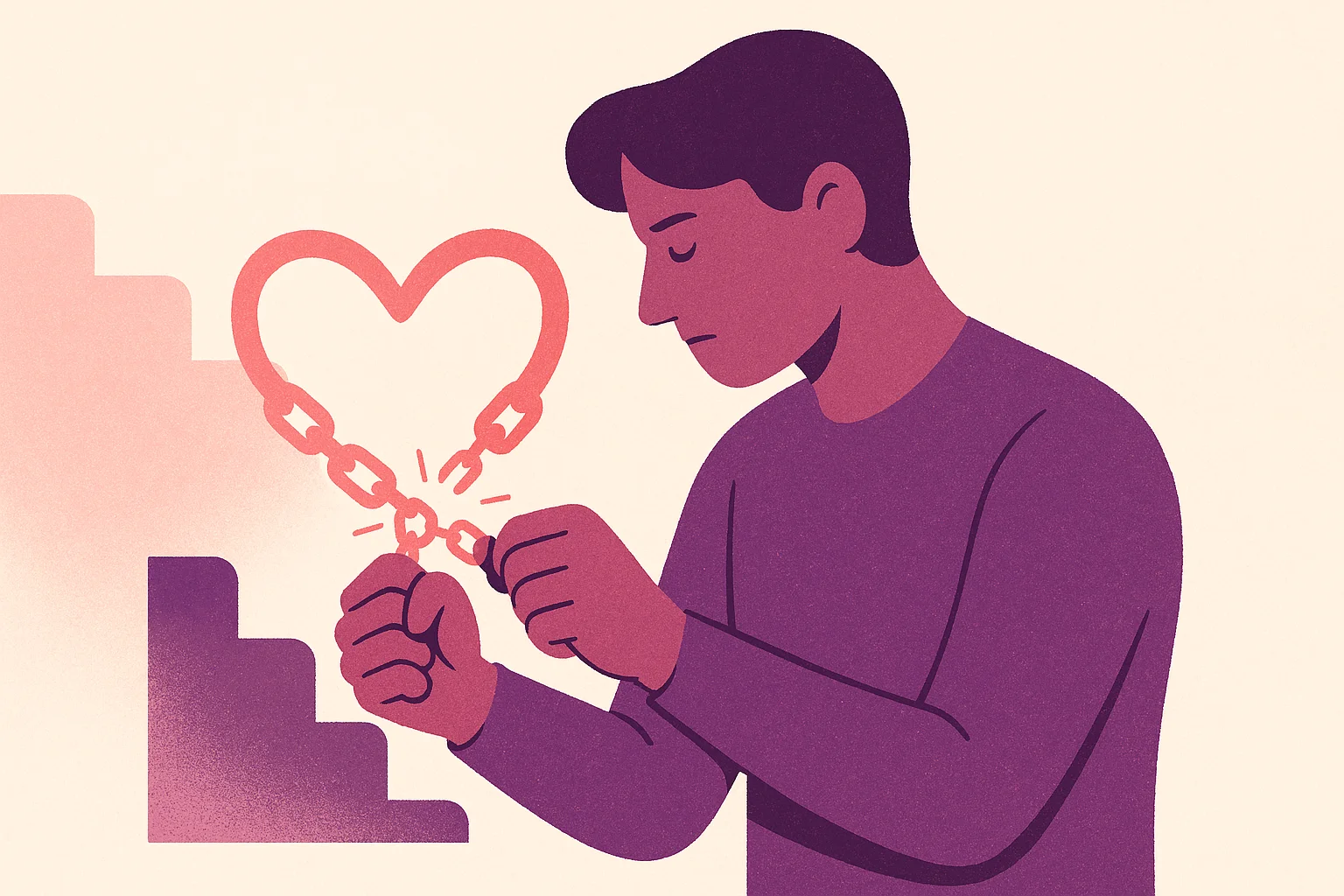
Quick summary
- Emotional dependency is a regulation reflex: you use the other person to calm your inner state.
- Phase 1 (weeks 1-2): stabilise, which means cutting the emergency behaviours.
- Phase 2 (weeks 3-6): reclaim your life, your friends, your desires, your «no».
- Phase 3 (months 2-3): consolidate an inner security that no longer depends on anyone.
- Relapses are part of the road. They're not a failure, they're a stage.
If you've ever searched for how to get out of emotional dependency, you know the song: «rebuild your confidence», «refocus on your needs», «learn to love yourself». True advice, no doubt. But perfectly unusable on a Tuesday night at 11pm, when you're staring at your phone waiting for his reply.
You leave emotional dependency behind with actions, small, precise and repeated, not with resolutions. Much like rehabbing a knee after an injury, in fact: nobody tells you «walk again», they give you exercises, in an order, with a progression.
That's what we're going to do here. Three phases, twelve exercises, from the most urgent to the deepest. You don't need to do everything perfectly, you just need to start with the first one. And before that, two minutes to understand what you're up against, because it changes how you do the exercises.
Two minutes to understand what you're up against
Emotional dependency is a regulation system: your anxiety is soothed through the other person, their messages, their presence, their proof of love. So the problem isn't that you love too much, it's that you've outsourced your emotional thermostat.
Why does that matter? Because it explains something everyone experiences and nobody understands: when you stop the dependency behaviours, the anxiety goes UP before it goes down. Not checking your phone doesn't feel good straight away, it hurts first! That's normal, it's the withdrawal from any soothing mechanism. If you know that wave is on the programme, you can ride it out instead of concluding that «it isn't working».
One last word before the exercises: if you're not yet sure this applies to you, the symptoms of emotional dependency are laid out area by area, and it's good preliminary reading. Now, to work.
Phase 1: stabilise (weeks 1 and 2)
The goal of this phase: cut the emergency behaviours, the ones that keep the anxiety-checking-relief circuit running. We're not trying to feel good yet, we're trying to stop feeding the machine.
- The 30-minute delay: Every time anxiety rises and pushes you towards an action, checking his phone activity, sending a «what are you up to?», asking for reassurance, you impose 30 minutes of waiting on yourself. Not a ban, just a delay! Most waves of anxiety subside on their own in 15 to 20 minutes, and you're going to discover that through experience, which changes everything.
- The wave journal: A notebook, three columns: the trigger (he read it without replying), the thought («he's getting tired of me»), the action you felt like taking. Keep it for a week, then reread it. YOUR pattern will appear, in three or four typical situations that come round on a loop. You can't defuse what you haven't mapped.
- Counting the checks: Count, without judging yourself, how many times a day you check your phone for HIM. Write the number down. Then set yourself a reasonable reduction target, half as many within a week, for example. What gets measured gets changed, and the falling number is a visible, concrete victory that belongs to you.
- Grounding for the peaks: For the big waves, the ones that don't pass in 30 minutes: five minutes of slow breathing (in for 4 seconds, out for 6), both feet on the floor, naming mentally what's happening: «this is a wave of anxiety, it will pass, like the others». Simple? Yes. Effective at the peak? Far more than people think.
| Emergency situation | Current reflex | Replacement action |
|---|---|---|
| He read it, didn't reply | Reread the conversation, send another message | 30-min delay + note the wave in the journal |
| He's going out without you tonight | Ask for news «casually» | Plan YOUR evening, before his |
| Your self-esteem drops suddenly | Look for proof of love | Reread your list from exercise 8 (patience, we'll get there) |
| Big wave, panic | Call, send message after message | 5 min of grounding, then decide with a cool head |
Phase 2: reclaim your life (weeks 3 to 6)
Phase 1 stopped the bleeding. Now we fill up. Because emotional dependency loves emptiness: the fewer things of your own you have in your life, the more the relationship takes up all the space.
- Two activities that are only yours: Not «projects», concretely: two weekly slots, in your diary, for things that existed before him or that you've always wanted to try. The success criterion is simple: during those hours, you don't think about the relationship. At first it will be hard, after three weeks they'll be your favourite hours.
- The tour of fallow friendships: You know, those friends who stopped suggesting things? Get back in touch, one a week, without justifying yourself, without a big speech. A «it's been way too long, when are we seeing each other?» is plenty. Every reactivated bond is one more point of support, and one percentage point less that the relationship weighs in your life.
- The practice «no»: Once a week, minimum, you say no to something you would have accepted out of fear of disappointing. Not necessarily to him, by the way! A favour that doesn't suit you, an outing that doesn't appeal. The «no» muscle is trained on small loads before lifting the heavy ones.
- The list of your own needs: One quiet evening, write down what YOU need in order to feel good, independently of him: sleep, sport, creating, time alone, laughing till you cry. Then look honestly at which ones you've abandoned. Keep that list: it's the one you'll reread when your self-esteem takes a dive (yes, that's the famous exercise 8 from the table).
Phase 3: consolidate (months 2 and 3)
The emergencies are handled, your life is filling up. What's left is the foundation: building an inner security that no longer depends on anyone. It's the slowest phase, and the one that pays off most.
- Scheduled solitude: One moment alone a week, chosen, ritualised: a coffee on a terrace, an exhibition, a walk. The point isn't to endure it, it's to teach your nervous system that solitude is a safe place. Chosen solitude has nothing in common with abandonment, and your body ends up feeling it.
- The worst-case letter: A demanding exercise, to do calmly: write what would happen, concretely, if the relationship ended. Not the fantasised emotional tsunami, the real sequence: where you'd live, who'd be around you, what you'd do in the first months. As you write, you'll discover something counter-intuitive: the worst-case scenario is painful, but you can survive it. And a fear you know you can get through loses most of its power.
- A relationship by choice, not by need: Regularly, ask yourself this question: «if I weren't afraid, what would I choose?» Staying has to become an answer, not a reflex. That's the great reversal of all this work: going from «I stay because I need to» to «I stay because I choose to». The day you feel the difference from the inside, you've won.
- The monthly review: Once a month, take out your phase 1 journal and compare: the frequency of the waves, their intensity, how fast you recover. Deep progress is invisible day to day and spectacular over three months. That appointment with yourself is also your best antidote to discouragement.
The traps on the way (everyone falls into them)
Three traps show up for almost everyone, and knowing them in advance is often enough to keep walking past them. Here they are.
Trap 1: believing that a relapse cancels everything
You'll hold out for ten days, then one anxious evening will sweep away your good resolutions, and so what? Relapse is part of the learning, the way you fall off while learning to ride a bike. What counts is the trend over three months, not last night.
Trap 2: changing partner instead of changing the pattern
Emotional dependency follows its owner! A new story with the same inner system will produce the same relationship, with a different first name. The work is now, not «once I've found someone better».
Trap 3: doing all this in secret, against someone
These exercises are work for you, not a strategy to make him react. If you're counting your days of silence while watching for his reaction, you're not getting out of dependency, you're just playing it in another form.
And the real last piece of advice: you don't have to walk this road alone. A therapist who knows cognitive behavioural therapy or attachment wounds speeds the work up enormously. On the reading side, the genre classic, «Codependent No More» by Melody Beattie, complements this plan very well if you want to go further on paper.
Before you start: measure your starting point
A set of questions assesses where you are today, healthy attachment, fragility or real dependency, and gives you a starting snapshot. Take it again in three months and measure the distance covered.
Set my starting pointFree · No sign-up · Instant result
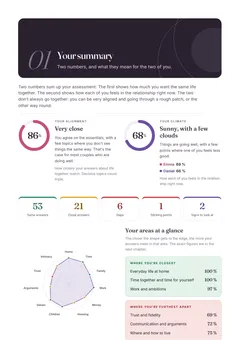
Relationship assessment -20% right now
The complete assessment of your relationship
About a hundred specific questions on money, children, where to live, fidelity... Each of you answers on your own side, or you answer alone if the other isn't ready, and you get a 40-page report that compares the answers, topic by topic.
- 100 questions, together or on your own
- Built on research in couple psychology
- A 40-page PDF report, with charts
Free questions · report Usual price: €9.90 Discounted price: €7.92 for both of you