Love or habit: why does this question haunt you?
Wondering whether you stay out of love or habit is never trivial. This question rarely appears at the start of a story: it surfaces after a few years, once the early passion has quieted and a silent doubt sets in. “Do I still really love them, or do I stay because it's comfortable?”
Routine isn't the enemy of love: on the contrary, a couple needs landmarks and security. The problem begins when only the routine is left: when desire, closeness and the urge to plan have given way to a simple cohabitation that runs on autopilot.
This test isn't a verdict and won't decide for you. It helps you put words on your feelings and tell a love that has matured apart from a relationship that survives on inertia alone. The next question, the one about leaving or staying, only comes up once this one has been settled.
Love or habit: what's the real difference?
The line is subtler than it seems, because lasting love sometimes looks like habit: fewer butterflies, more calm. The real difference isn't read in intensity, but in what drives you deep down.
To see clearly, look at two things: desire (do you still want this person, want to surprise them, discover them?) and choice (do you stay because you want to, or because leaving is frightening?).
- •A love that has matured: the passion has calmed, but you still choose your partner, you still want them, you build and laugh together.
- •A relationship out of habit: you stay mostly for comfort, out of fear of being alone or of change. Desire, closeness and shared plans have gone out.
Love is choosing the other again and again. Habit is staying because you've forgotten you had a choice.
How to read your result
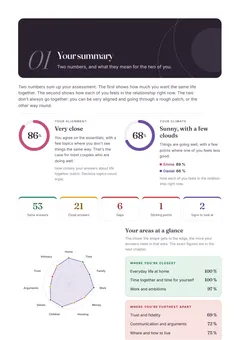
Each question carries a weight matching how serious it is, and each answer a value matching its rank. The total runs from 0 to 205 points. The higher your score, the more habit outweighs love. Here's how to read your result: an indicator to reflect on, not a sentence.
| Total score | What prevails | What it means |
|---|---|---|
| 0 to 51 points | A love that's very much alive | Love clearly wins. The passion has turned into deep attachment, but the desire and closeness are still there. |
| 52 to 103 points | Love wins, routine is settling in | The feelings are real, but routine is nibbling away. A gentle signal to reinvest in your relationship. |
| 104 to 155 points | Habit is taking over | Daily life has taken more room than the pull of love. Real awareness is needed. |
| 156 to 205 points | Mostly habit | It's comfort or fear that hold you, more than love. An honest time of reflection is necessary. |
Why love (sometimes) turns into habit
If your score leans toward habit, don't blame yourself: this drift is extremely common, and it can be explained. Love doesn't vanish all at once: it falls asleep when we stop tending to it.
Three mechanisms, above all, gradually turn the pull of love into simple cohabitation:
1. The wear of daily life
Work, kids, chores, fatigue: logistics devour the couple's time and energy. You end up managing a shared life rather than living it, and moments together come last, after everything else.
2. The disappearance of novelty
At the start, everything is discovery, and the brain releases dopamine: hence the famous butterflies. Over time, you think you've “figured the other out”. Without novelty or surprise, the excitement fades and routine sets in.
3. Attention and effort stop
You take each other for granted, so you stop seducing, complimenting, taking care of one another. Yet love feeds precisely on those small attentions. When they stop, often because one or the other no longer makes any effort, the bond cools.
The signs that habit has taken over
Beyond the score, some signals don't lie. If you recognise several, it's not necessarily the end, but it's time to react before the distance becomes irreversible.
Desire and tenderness have gone
No more spontaneous gestures, no more attraction, an intimacy that has become rare or mechanical. When you no longer touch or want each other, it's often one of the first signs the flame is weakening.
Exchanges are limited to logistics
Your conversations revolve around the shopping, the schedule and the kids, but no longer around your feelings, your dreams or your desires. This lack of deep communication slowly empties the relationship of its substance.
You stay out of fear, not desire
Fear of loneliness, of others' judgement, of starting over, or of material constraints weighs more than the wish to be together. Staying “because it's simpler” is the clearest marker of a relationship out of habit.
You no longer miss each other
When you're apart, you don't miss the other, sometimes you even savour those moments alone. Indifference, even more than conflict, is the sign that the attachment has loosened.
Love or habit: what to do with your result?
Whatever your score, remember one thing: a result is not a decision. It's a starting point to reflect: first alone, then ideally together. Routine can be treated, provided you name it and want to act.
If habit dominates, two opposite mistakes await you: doing nothing and hoping it passes, or blowing everything up on a whim. Between the two lies a real path.
What's better to avoid
Drifting without deciding anything
Staying out of pure inertia, waiting for it to “come back on its own”, is the surest way to let the relationship fade. Sleeping love doesn't wake up without a conscious move on your part.
Blowing everything up on a whim
Conversely, leaving abruptly in a fit of weariness can become a regret. A drop in desire isn't always an ending, sometimes it's a signal to reinvest in the couple before concluding.
What's helpful to do
Rekindle the flame, on purpose
Recreate novelty: outings, surprises, plans, new experiences together. Bring back the small attentions of the early days. There are many ways to revive a couple that's falling asleep, as long as you get back to it together.
Really talk to each other
Dare to have the honest conversation: “Where are you with us? What do you want?”. Love often hasn't died, it's just being spoken in a language the other person no longer receives: rediscovering each other's love language can revive a connection you thought was gone.
Give yourself time to reflect (or get help)
If the doubt persists, take the time to untangle love from fear. Asking yourself whether it's really the right person, or seeing a couples therapist, helps you decide consciously rather than drift.
The takeaway: routine isn't a fate
Asking “love or habit?” isn't a sign that it's all over: on the contrary, it's proof that something in you still holds on to this relationship and refuses to let it fade in silence.
Most couples go through phases where habit takes over. What makes the difference isn't avoiding it, it's noticing it and acting. A love can be revived; you just have to decide it together, and a relationship where the decision is still taken together is a healthy relationship, whatever dose of habit has settled into it.
Listen to what this test stirs in you. Your feeling, more than your score, is the best compass for knowing what you truly want to live.