What is a karmic relationship?
In spiritual vocabulary, a karmic relationship is a bond that is not there to last but to teach you something. The word comes from the Sanskrit karma, meaning « action »: on this reading, two people meet again in this life because a story begun elsewhere was never finished. Hence the talk of a debt to settle, a soul contract, a lesson to understand.
What is striking is not the definition but how consistent the portrait is. People who recognise themselves in the term almost always describe the same thing: an immediate and disproportionate attraction, the unsettling sense of already knowing each other, then cycles of breakup and reunion that repeat without anything ever being resolved. A great deal of intensity, very little peace. A karmic relationship is never lukewarm, and that is exactly what makes it so hard to leave.
Let us be straightforward: nothing proves that past lives exist, and this test will not settle that question. What it does measure is perfectly observable: repetition, exhaustion, the difficulty of leaving, the feeling of replaying a familiar scene. Whether you call that karma or simply a relational pattern, the facts you describe stay the same. The spiritual vocabulary gives you an image, the test gives you a measurement.
The 7 signs of a karmic relationship
No single sign is enough on its own. It is their accumulation that draws what people call a karmic bond, and that is exactly what the test weighs up question after question.
Instant recognition
From the first exchanges, you felt you had known this person forever. That sense of familiarity is the most universally cited sign, and often the one that gives the meeting its flavour of destiny.
A whirlwind start
Everything moved very fast: passionate declarations, immediate plans, the feeling of having found the missing piece. That flying start looks a lot like what is known as love bombing, and it creates a powerful attachment before you have really got to know each other.
Breakups followed by reunions
You have already split up once, twice, more. And you came back, always for the same reasons, with the same conviction that this time would be different. This is the most characteristic marker of a karmic bond.
The same argument on a loop
It is not that you argue a lot: it is that you always argue the same way, with the same sentences and the same ending. Nothing gets resolved, everything gets replayed.
A tiredness that is hard to explain
After time together you feel drained rather than recharged. Knots in your stomach, sleepless nights, a phone checked every five minutes: your body registers what your mind plays down.
The impossibility of leaving
You know this relationship is damaging you, you have already tried to leave, and you cannot. That powerlessness has a far more down to earth name than karma: it looks a great deal like emotional dependency.
The sense of a debt
You feel you owe this person something without being able to say what. It is that feeling, more than love, that holds you there. In the karmic reading, that is precisely the debt to be settled.
How to read your result
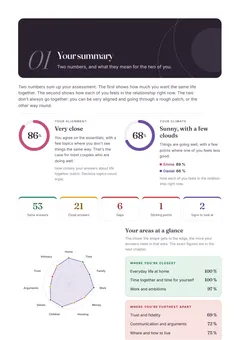
Each of the 20 questions offers three readings of the same situation, tied to three axes: the peaceful bond, the mirror bond and the karmic bond. The axis that comes up most often determines your profile, and the percentages shown at the end give you the exact balance of all three.
| Your profile | What it indicates | What you can do with it |
|---|---|---|
| Peaceful bond | Your relationship does not go round in circles. You stay because you are happy, not because you cannot leave. | Do not mistake calm for dullness. Keep nurturing what makes the relationship safe, starting with the freedom to say anything. |
| Karmic echoes | Part of your story repeats itself, but the rest of the relationship holds up and does you good. | Identify the precise loop and talk about it while the relationship is still solid enough to hear it. |
| Mirror bond | The relationship shakes you and transforms you, but every trial you have been through left you stronger. | Check every six months that you are doing better than before. As long as that holds, the bond is doing its work. |
| Karmic relationship | Repetition dominates: breakup cycles, the same argument, exhaustion, difficulty leaving. | For three weeks, note how you feel after each moment spent together, then read it back with a cool head. |
Karmic relationship, soulmate or twin flame?
These are the three terms you find everywhere, and they get confused constantly. The simplest way to tell them apart is not to ask how much you love each other, but what state you come out of the relationship in.
| Type of bond | What you feel | What it becomes |
|---|---|---|
| Soulmate | Relief. The relationship rests you, supports you and makes you more available for the rest of your life. | It lasts, or it ends without destruction. You come out of it intact. |
| Twin flame | A mirror. The relationship confronts you with what you were avoiding, with separations that hurt but move you forward. | It transforms. Whether it lasts or not, you do not come out of it the same person. |
| Karmic relationship | A loop. The same scene plays out endlessly, the intensity remains, the exhaustion settles in. | It stops the day one of the two stops feeding the cycle. Rarely before. |
These three categories are not diagnoses and have no medical value. They are images, useful because they put words on very concrete feelings. If you are looking for a different reading of the same subject, our love compatibility test approaches the bond through values rather than intensity.
What psychology sees behind the same signs
Here is the point that interests most people who take this test: the signs described above are not imaginary. They are in fact remarkably consistent from one account to the next. Psychology does not deny them, it explains them differently, and its explanation has the advantage of being verifiable.
Three mechanisms are enough to produce most of what gets attributed to karma.
Intermittent reinforcement
An unpredictable reward creates a far stronger attachment than a regular one. That is the principle behind slot machines. When a relationship alternates wonderful moments and freezing silences, attachment gets reinforced instead of fading. It is the best explanation for why the most unstable relationships are also the hardest to leave.
Attachment style
The panicked fear of abandonment, the need to check, the inability to be alone: these reactions do not come from the other person, they come from how you learned to attach. Two opposite styles meeting produce the pursuit and withdrawal cycle almost mechanically. Our attachment style test explores exactly that.
Familiarity mistaken for destiny
The famous « I feel like I have known you forever » has a simple and slightly dizzying explanation: you are recognising a pattern, not a soul. A dynamic already lived through, in childhood or in a previous relationship, feels familiar. The brain reads that familiarity as obviousness, when what it mainly signals is that you already know how to play this role.
How to get out of a karmic relationship
On the spiritual reading, a karmic relationship ends when the lesson is understood. It is a lovely formula, but it has a flaw: it implies you should stay until understanding arrives. In practice it is almost always the other way round. You understand after leaving, not before.
If your result leans karmic, these few markers are worth more than a long theory.
What keeps the loop going
Waiting until you have understood
Looking for the hidden meaning of the relationship is a very elegant way of changing nothing. As long as you are searching for the lesson, you stay, and as long as you stay, the cycle keeps turning.
Staying « just friends »
Contact kept up after a breakup sustains exactly the attachment you are trying to undo. It is the number one reason people go back, far more than the feelings themselves.
What closes it
Write down facts, not impressions
Note what happened, what was said, and how you felt afterwards. Read back with a cool head, a log of facts stands up to nostalgia far better than memory, which has the unfortunate habit of keeping only the good moments.
Set a clear boundary and watch
State a simple boundary about a specific behaviour, then watch what happens. A healthy relationship adjusts, a looping one escalates or promises without changing anything. The answer will teach you more than ten conversations.
Look at what was pulling you in
The useful question is not « why does he or she do that? » but « why does it hook me so much? ». It is the only part of the equation you have any power over, and it is also the part that will stop you starting again with someone else.
Do not stay alone with it
A trusted friend, a psychologist, a support group: the format matters little, what matters is getting out of the closed circle. A loop is always easier to see from outside than from within.
Frequently asked questions about karmic relationships
What is a karmic relationship?
It is a term from spiritual vocabulary describing an intense, repetitive bond said to exist in order to teach you something rather than to last. Its origin is attributed to a past life, in the form of a debt to settle. In practice, the people concerned describe an immediate attraction, a sense of déjà vu, cycles of breakup and reunion, and a lot of tiredness.
What are the signs of a karmic relationship?
The seven signs that come up most often are instant recognition, a whirlwind start, breakups followed by reunions, the same argument going round in circles, unexplained tiredness, the impossibility of leaving despite the pain, and the feeling of owing the other person something. It is their accumulation that counts, not any single sign.
What is the difference between a karmic relationship and a twin flame?
Both bonds are intense, but they leave you in different states. A twin flame acts as a mirror: it shakes you, it transforms you, and you come out changed but stronger. A karmic relationship repeats itself without resolving anything and leaves you exhausted. The question to ask is simple: after each trial, are you doing better or worse than before?
How does a karmic relationship end?
It stops the day one of the two people stops feeding the cycle, which almost always means cutting contact cleanly. The spiritual formula says it ends « when the lesson is understood », but in practice understanding comes after leaving, rarely before. Staying while you wait to understand is the surest way to prolong the loop.
Is this karmic relationship test reliable?
It is a thinking tool, not a diagnosis. It does not assess your past lives, it measures what is observable in your current relationship: repetition, the balance of effort, your state after each moment spent together. The result is therefore worth exactly what your answers are worth, and it gains from being reread with a clear head.
The takeaway
A karmic relationship is not a punishment, and you owe no debt to anyone. Above all, remember this: intensity is not proof of love, and a lesson that costs you your health is not a lesson.
This test is neither a diagnosis nor a verdict. It is a mirror held up to what you are living, and a vocabulary for talking about it. If the result surprised you, the most useful question remains the simplest one: what state does this relationship leave you in once the door closes? Our healthy relationship test asks the same question from another angle.
And if your relationship involves fear, control, humiliation or violence, this is no longer about karma. A toxic relationship and the hold of a narcissistic partner show up through precise signs, and talking to a professional remains the best decision.