Emotional dependency is not “loving too much”
The two get confused all the time, and the confusion suits everyone. “I'm like this because I love you too much” sounds better than the truth.
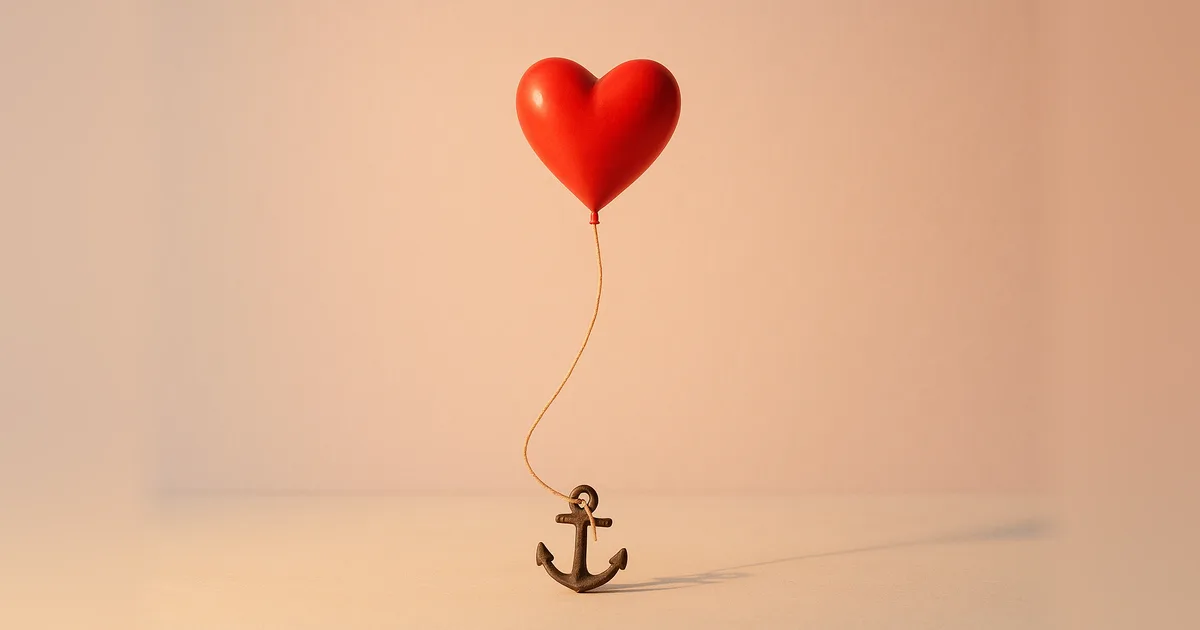
Loving means wanting the other person's presence. Depending means being unable to bear their absence. The nuance looks thin on paper and changes everything in real life: in the first case, your partner adds something to a life that already stands on its own. In the second, they have become the load-bearing wall, and you spend your days watching to make sure it doesn't move.
Emotional dependency is not a medical diagnosis, and it isn't proof of love either. It's a way of functioning: needing the other person in order to feel that you exist, fear of abandonment as the compass for every decision, the gradual erasing of who you were before.
What makes it hard to spot in yourself is that it looks deceptively like the first months of a passion. Except passion settles down and leaves a relationship behind it. Dependency settles in, and it grows precisely where your personal life retreats.
“You cannot be happy as a couple if you don't know how to exist alone.”
Loving deeply or depending: the table that helps you decide
The same behaviour can be tender or worrying depending on what drives it. This table compares the two versions, situation by situation.
| Situation | Healthy attachment | Emotional dependency |
|---|---|---|
| They don't reply | You notice, your day carries on | Anxiety climbs, you send message after message |
| A weekend apart | You miss them a bit, it does you good too | It's an ordeal, you count the hours |
| A serious disagreement | You stand your ground | You give in: conflict feels like a breakup risk |
| Their friends, their nights out | Their social life doesn't threaten you | Every outing without you wakes the fear of being replaced |
| Your self-worth | It also exists outside the couple | It depends entirely on how they look at you |
The signs that should alert you
No single sign is enough to talk about emotional dependency. Everyone has reread a message three times or taken a silence badly. It's accumulation and repetition that should alert you: when these reactions become your default mode.
Three families of signs come up in most people concerned:
Your body speaks
Knotted stomach when they don't reply, insomnia when they pull away, physical relief when the phone finally vibrates. Emotional dependency lives in the body first, before the thoughts. If your partner's absence triggers symptoms close to withdrawal, that's no longer tenderness, it's a signal.
Your world shrinks
The friends you no longer see, the passion abandoned “for lack of time”, the personal projects postponed. The shrinking happens gently, choice after choice, and you only measure it looking back: what is left in your life that doesn't involve your partner?
Fear decides in your place
You don't say what bothers you, you accept what hurts you, you test their love by provoking crises. Behind these three behaviours, the same engine: the conviction that expressing a need or setting a limit could drive the other person away. When the fear of losing someone steers your choices, the relationship is already off balance.
Where does emotional dependency come from?
Nobody chooses to become emotionally dependent. The psychiatrist John Bowlby's work on attachment, extended by Mary Ainsworth's experiments, showed that the way we love as adults is built very early: a child whose attachment figures were unpredictable (present one day, absent the next) learns that love can vanish at any moment, and that it must be watched.
As an adult, the same reflex replays in the couple: hypervigilance at the slightest sign of distance, constant need for reassurance, panic at the idea of abandonment. This is what we call anxious attachment, and knowing your attachment style often sheds sudden light on years of misunderstood reactions.
Childhood doesn't explain everything. Fragile self-esteem, a brutal breakup that never healed properly or a previous toxic relationship can install the same reflexes in someone who didn't have them. Emotional dependency is a learned mechanism, and that is excellent news: what has been learned can be unlearned.
Recognising yourself in these lines is not a verdict. Attachment style is not a permanent box: researchers speak of “earned security” to describe anxious people who became secure, through experience or through work on themselves.
What dependency does to your relationship
The cruel paradox of emotional dependency: it damages precisely the relationship it is trying to protect.
Getting out: where you start
Emotional dependency is not a life sentence, but you don't get out by willpower alone, and certainly not by repeating “I need to be less clingy”. Here are the steps that come up in most successful journeys.
1. Name what is happening
This may be the step you're taking right now. Putting the right word on the mechanism changes the question: it's no longer “why do I love them too much?” but “why am I so afraid of losing them?”. The second one has answers.
2. Reclaim your own territory
An activity of yours, friends of yours, a project of yours. Not to make the other person jealous, not to “take some distance”, but to rebuild what existed before: a life that stands without a crutch. Start small: one evening a week is enough to restart the machine.
3. Sit with the discomfort instead of fleeing it
Not sending the third message. Letting the silence exist without filling it. Saying “this doesn't work for me” and enduring the minutes that follow. Every time you cross the anxiety without giving in to the reflex, you teach your alarm system that it is ringing for nothing.
4. Get support if it resists
When the fear of abandonment is old and deep, a psychologist or therapist is the most effective shortcut, and cognitive behavioural therapies in particular are well documented on this subject. Understanding the mechanics of emotional dependency also helps you move forward between sessions.
Emotional dependency or dependent personality: don't mix everything up
A point of honesty, because everything gets mixed up on this subject online. The emotional dependency this page talks about is a widespread relational pattern, not an illness. It causes suffering, it can be worked on, but it cannot be diagnosed.
There also exists, in psychiatric classifications such as the DSM-5, a dependent personality disorder: a pervasive need to be taken care of that touches every sphere of life, not just the couple, and which belongs to mental health professionals.
If your dependency extends far beyond your romantic relationship, if it comes with intense distress, dark thoughts or an inability to function day to day, an online test is no longer what you need: talk to your doctor or a psychologist. There is no shame in it: it is actually the strongest decision on this list.
“The goal is not to need nobody. It is to choose someone freely, rather than clinging to them out of fear.”
How this test works
Twenty concrete situations, four possible reactions each time, from the most autonomous to the most dependent. No trick questions, no right answers: the test measures the frequency and intensity of your anxious reflexes as a couple, on the registers where dependency really shows: the body, decisions, limits, the fear of emptiness.
Your score places you on four levels, from solid emotional autonomy to dependency that hurts, each with an analysis and tailored next steps. Answer with what you actually do, not with what you would like to do: the test is only worth as much as your honesty.
This test is a self-observation tool, not a diagnosis. No online questionnaire replaces the opinion of a mental health professional. If your answers worry you, that is who you should turn to.