Each on your own phone
Together
- You each answer on your own side, at your own pace
- Nobody sees the other's answers before the end
- The report compares your two sets of answers, topic by topic
Relationship assessment
100 questions across twelve areas of life together, and a 40-page report that tells you, topic by topic, where you meet and what you need to talk about.
-20% right nowUsual price: €9.90 Discounted price: €7.92for the couple, in one go
Free questions · €7.92 for the report, at the end · One-off payment, no subscription · See the report page by page
Sample report · fictional couple
Emma & Daniel
Alignment
12
areas of life together
100
questions or so
25 min
each, at your own pace
40 pages
of report, with charts
A session with a relationship counsellor costs between £50 and £90. Starting with Quiz Couple's full assessment is THE right first step.
Most couples do it together. But when things are rough, or the other doesn't feel like talking about it, you can also do it on your side: you answer for yourself, then say what your partner would answer, and the report shows you what you know, what you assume and what you don't know.
Each on your own phone
Without telling your partner
Same price, same report. If one day your partner wants to answer too, an assessment done together will replace your assumptions with their answers.
A real document of about forty pages, with its chapters, its charts and, for each gap, ways to talk about it. Scroll through.
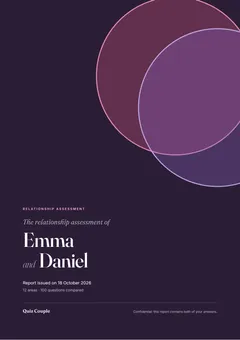
Your two first names, the date, and the number of questions compared.
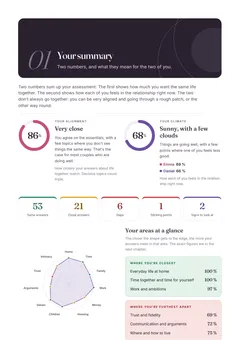
Two figures: your alignment and the mood of your relationship. Then your areas at a glance, on a radar.
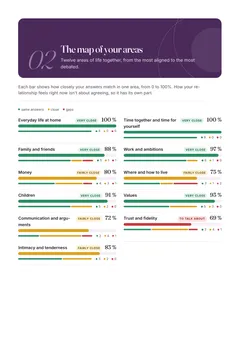
One bar per area, from 0 to 100%, with the detail of same answers, close answers and gaps.
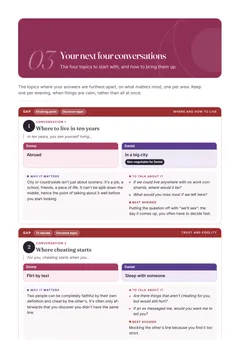
The topics to start with, your two answers side by side, why it matters, questions to talk it through and what's best avoided.
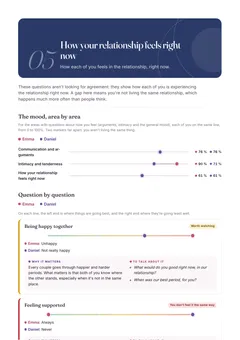
How each of you feels in the relationship, area by area, on the same line.
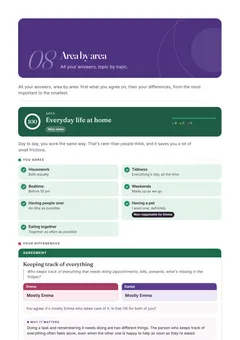
All your answers: what you agree on first, then your differences, from the most important to the smallest.
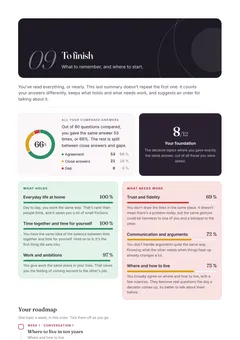
A second summary, different from the first: how your answers split, your foundation, what holds, what needs work, and a roadmap.
Pages from a sample report. Emma and Daniel are a fictional couple.
2 min
Your two first names, seven questions about your situation (do you live together, do you have children...). Together, you send its link to your partner; on your own, you start right away.
25 to 30 min
On your phone, at your own pace, in one go or several: everything is saved. On your own, you answer each question twice: for yourself, then for the other, as far as you can tell.
1 min
As soon as you've finished your answers: €7.92 for both of you, by card, Apple Pay or Google Pay. The questions themselves are free.
6 months online
The PDF link arrives by email as soon as everything is answered, and the report stays online for six months. It ends with a roadmap: one topic a week.
Concrete things, not generalities: the questions are about the fridge, the rent, the in-laws and the phone on the bedside table.
Who does what, who thinks of what, tidiness, meals, bedtime.
Time together, time for yourself, going out, small attentions.
Your families, your friends, the end-of-year holidays, an ageing parent.
The place of work, ambitions, a pay gap, changing careers.
Joint account or not, spending, savings, helping family.
Where to live in ten years, buying a home, moving for the other.
Having them, when, how many, how to raise them, who looks after them.
Religion, marriage, the environment, traditions, politics.
How you argue, and how you make up.
The other's phone, jealousy, exes, what cheating means.
Rhythm, tenderness, talking about it, trying new things.
How each of you feels in the relationship, right now.
Just as they're asked in the assessment, here as Emma saw them. Answer to see what the report does with them.
Everyday life at home
You
Daniel
answers on his side
Why it matters
Doing a task and remembering it needs doing are two different things. The person who keeps track of everything often feels alone, even when the other one is happy to help as soon as they're asked.
Money
You
Daniel
answers on his side
Why it matters
It's not the amount that upsets people, it's finding out about the purchase afterwards. Setting a threshold together avoids both feeling watched and nasty surprises.
Trust and fidelity
You
Daniel
answers on his side
Why it matters
Two people can be completely faithful by their own definition and cheat by the other's. It's often only afterwards that you discover you didn't have the same line.
In the report, your answer is set against your partner's, with why it matters and questions to talk it through.
On the big questions (children, where to live, fidelity...), each of you can also mark an answer as a deal-breaker. The report then starts there.
You don't need to be in trouble to do an assessment. Most couples do it at a very specific moment:
Moving in, getting married, having a child, buying together. It's the right time to check that you want the same thing, before committing.
Often, behind an argument that keeps coming back, there's a gap nobody has ever named. The report puts it on the table, without blaming anyone.
You feel less close, or you're not quite sure where you stand anymore. The assessment helps put words on what each of you is going through, and you can do it on your own if the other isn't ready.
So that it lasts! Solid couples talk about touchy subjects before they get touchy, and the assessment gives them the chance.
Three ways of taking stock, which don't serve the same purpose. Here's what each one brings.
The assessment doesn't replace a relationship counsellor: it gives you a picture of your relationship, topic by topic, so you know what to talk about. Many couples use it precisely as a starting point, together or with a professional.
The questions don't come out of nowhere. They're based on research in the psychology and sociology of couples: studies that followed thousands of couples for years, theses on how housework is shared, and the premarital questionnaires that couples counsellors have been using for decades.
The assessment isn't a clinical test and doesn't replace a professional. It's a serious questionnaire, built from what research knows about couples, to help you talk about the right topics.
Couples too often forget to take stock of their relationship. 30 minutes each and a few euros can really change things.
-20% right now
Usual price: €9.90 Discounted price: €7.92
for the couple, in one go
Code LOVE20 applied automatically at checkout
You only pay at the end, once your answers are in. One payment, by either of you. No subscription, no account.
You each access the assessment through your own link. No password, and an email address only to send you the link to the report.
Neither you nor your partner sees the other's answers before you've both finished. On your own, your partner is never contacted.
An unpaid assessment is erased 60 days after the last answer, a paid one six months after payment. Either of you can delete it before, in one click.
Payment goes through Stripe (card, Apple Pay, Google Pay). We never see your card.
Allow 25 to 30 minutes each, for 100 questions. Nothing forces you to do it all at once: every answer is saved, and you pick up where you left off.
Yes, once you've both finished: the report puts your two answers side by side, that's the whole point. Before that, nobody sees anything.
Because the result is the report: your two sets of answers compared, topic by topic, with ways to talk about them. The questions are free, and you only pay once your answers are finished, if you want the report.
Yes. You answer for yourself, then you say what your partner would answer, or "I don't know". The report compares your answers with what you imagine theirs to be, and gathers your blind spots: the topics you don't know about, ready to be asked. Same price, same report.
No. Nothing is sent to them, nobody contacts them, and only you see the report. Their first name is only used to write the questions.
Yes. At the start, you describe your situation in seven questions, and the questions adapt: a couple who don't live together yet answer about what they imagine, a couple without children about what they want.
It's common, and it isn't bad news: a gap you know about can be discussed, a gap you ignore ends up coming back as an argument. The report tells you where to start, and how to talk about it without it turning into a trial.
Yes. The questions draw on research in couple psychology and on the questionnaires relationship counsellors use before a marriage. The assessment isn't a clinical test for all that: it's a tool for talking, not a diagnosis.
No. It's a tool to put words on what you're going through and know what to talk about. If you're going through a hard time, a relationship counsellor or couples therapist can support you, and the report can serve as a starting point.
By card, Apple Pay or Google Pay, on Stripe's secure payment page. One payment of €7.92 for both of you, once you've finished your answers. You receive a receipt by email, and the report as soon as everything is answered.
The report is made from your answers, and it sometimes says something other than what you hoped. Once provided, it isn't refunded: it's digital content, and you ask to receive it right away before paying. As long as it hasn't been provided, you can withdraw and be refunded. And if there's a problem with the file, we sort it out.
They're used only for your assessment, never sold and never used for advertising. They're erased 60 days after the last answer if the assessment isn't paid for, six months after payment otherwise, and either of you can delete everything before.
Twenty-five minutes each, and you'll know what you agree on, and what you need to talk about. Start whenever you want: you can pause at any time.
Free questions · €7.92 for the report, at the end · One-off payment, no subscription
Together, this assessment shows each of you the other's answers. If you're afraid of your partner, do it on your own, or not at all: a domestic abuse helpline can talk with you, free and anonymously.
Loading...