
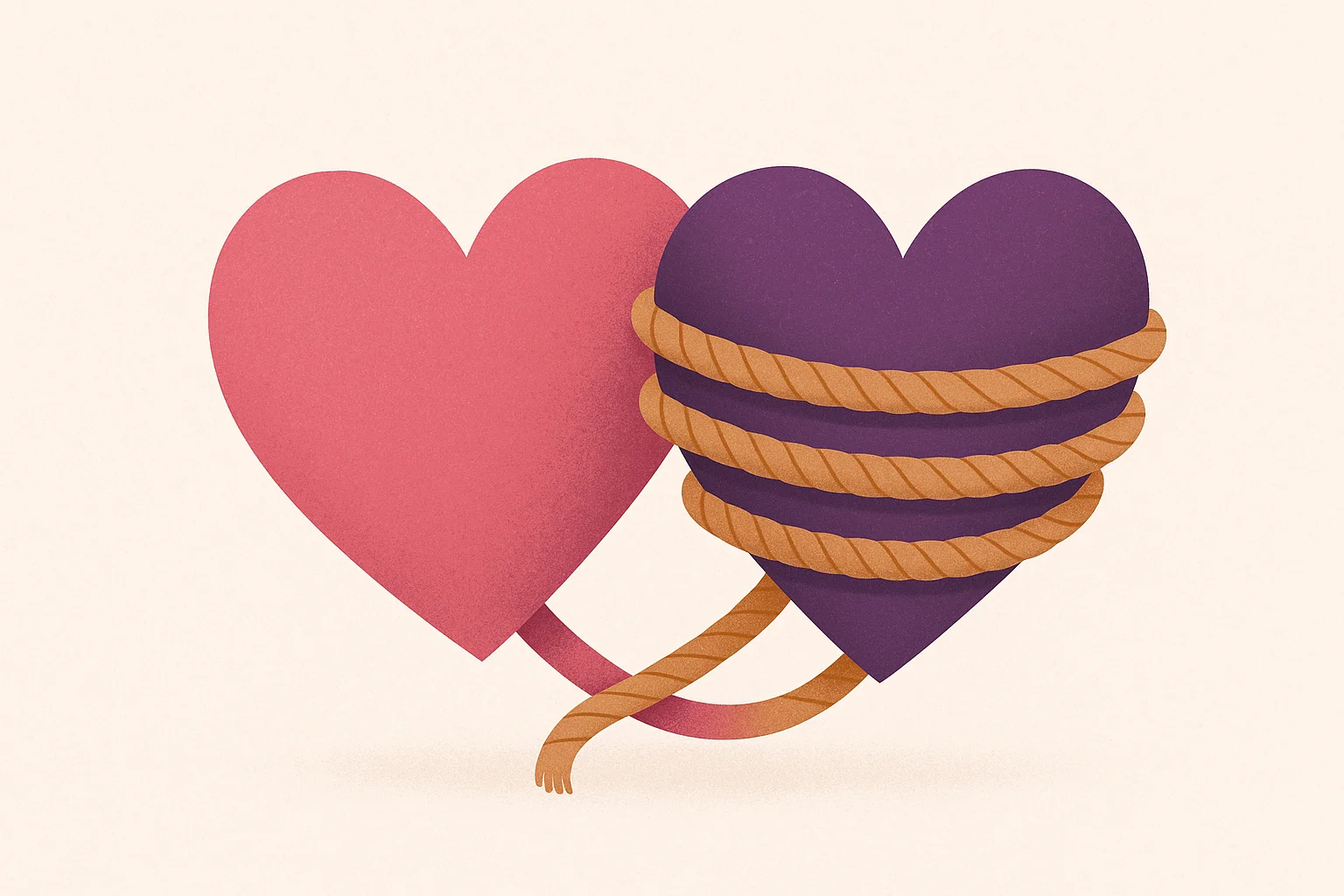
Quick summary
- Intensity settles nothing: love and dependency can be equally strong.
- The real difference is direction: love goes towards the other person, dependency flees an emptiness.
- The core marker: what you feel when everything is fine. Dependency is afraid even on good days.
- The mental test of a weekend without news settles it in five minutes.
- Love and dependency often coexist: you can genuinely love AND love badly.
It's a question we don't quite dare ask ourselves, because it's a bit frightening: do I love him... or do I mainly love the fact that he's there? Is it love, this thing that grips my stomach when he doesn't reply? Or something else?
The confusion is normal: from the inside, intense love and emotional dependency look very similar. In both cases you think about him constantly, you hate his absence, you feel strongly. The difference lies elsewhere, in the direction: love carries you towards him, dependency makes you flee an emptiness.
Let's make this very concrete, with the 7 differences that separate the two and a mental experiment worth more than any speech.
The 7 differences that don't lie
Take each line and ask yourself honestly which side you recognise yourself in most often. Not once in a while: most of the time.
| Love | Emotional dependency | |
|---|---|---|
| When everything is fine | You simply enjoy it | You're already watching for the moment it goes wrong |
| His absence | You miss him, and your life goes on | You're in withdrawal, and your life stops |
| What pushes you towards him | Desire: his presence adds something | Fear: his absence threatens |
| Your identity | The relationship is added to who you are | The relationship replaces who you are |
| Disagreements | Uncomfortable, but possible | Unthinkable: you give in before even speaking |
| His freedom | His own life doesn't threaten you | Every outing without you is an alert |
| The question of leaving | «I don't want us to split up» | «I can't have him leave me» |
The last line is the most important. «I don't want to» is a choice that speaks of love. «I can't» is an impossibility that speaks of survival, and love isn't supposed to be a matter of survival.
The mental experiment that settles everything: the weekend without news
Close your eyes for two minutes and seriously imagine this: he goes away for a whole weekend, with friends, somewhere with no signal. No news from Friday evening to Sunday evening. Nothing worrying, nothing hidden, just silence.
Now observe what that sets off in you. Not what you'd like to feel: what you actually feel, right now, just imagining it.
Scenario A: you're not thrilled, you'll miss him, but you can already see what you'd do with your weekend. An evening with your sister, a lie-in, that thing you've been putting off for weeks. On Sunday evening you'd be happy to see him and swap stories.
Scenario B: just thinking about it makes your stomach tighten. Two days without knowing? You already know you'd check your phone every ten minutes, that your weekend would be a waiting room, and that by Sunday you'd resent him, while resenting yourself for resenting him.
You've just measured something precise: the part of your attachment that is security, and the part that is fear. Scenario B, at that level, isn't overflowing love, it's an alarm system that has taken over the controls. The symptoms of emotional dependency break that system down piece by piece, if you want to check more finely.
The most common case: both at once
Now for the nuance that matters most: in real life it's almost never one or the other. You can genuinely love someone AND love them in a dependent way. The love is real, the partner is well chosen, it's the way of loving that is trapped.
How do you tell? Look at what your relationship amplifies. Secure love amplifies the best in you: you dare more, you laugh more easily. Dependent attachment amplifies your fears: you monitor everything, you apologise constantly, and little by little you shrink. Same person, same love perhaps, but two opposite directions.
And that's excellent news, in fact. Because if the problem isn't the person but the attachment style, then there's nothing to break: there's something to repair, in you, for you. And overcoming emotional dependency is a marked path, exercise by exercise, that works perfectly well without leaving anyone.
So, love or dependency? Answering it for good
Three things to do to stop going round in circles.
Go back over the 7 differences and count your lines. Do the weekend test, for real if the chance comes up: imagined answers are useful, lived answers are definitive. And talk about it with someone who knew you before him. Ask them THE awkward question: «how do I seem to you, since I've been with him?»
And if you want a calm, structured measure that doesn't depend on your mood that evening...
Love, habit or dependency: measure it properly
A set of questions assesses your attachment style through the concrete situations in this article. Five minutes, a clear result, and finally an answer that doesn't change from day to day.
Get my answerFree · No sign-up · Instant result
One last thing. If you discover that your way of loving leans towards dependency, don't turn that into a verdict on your story. It doesn't mean your love is fake, nor that your relationship is doomed. It means you love with an old fear clinging to your back, and that fear can be set down. Plenty of couples go through this work and come out with a lighter bond than before. Yours can too.
Read alsoEmotional dependency: when loving becomes a vital need
Relationship assessment -20% right now
The complete assessment of your relationship
About a hundred specific questions on money, children, where to live, fidelity... Each of you answers on your own side, or you answer alone if the other isn't ready, and you get a 40-page report that compares the answers, topic by topic.
- 100 questions, together or on your own
- Built on research in couple psychology
- A 40-page PDF report, with charts
Free questions · report Usual price: €9.90 Discounted price: €7.92 for both of you