

Quick summary
- Love bombing is a phase of massive, accelerated seduction designed to create attachment before you've had time to assess the person.
- It follows a three-part cycle: idealisation, devaluation, then rejection or a forceful return.
- Genuine passion and love bombing look almost identical at the start. The difference isn't the intensity, it's the reaction to a boundary.
- The test that settles it: set an ordinary boundary and watch. A healthy partner accepts it. A love bomber turns it into a drama.
- If you're already inside the cycle, struggling to leave isn't a lack of willpower, it's how the mechanism is built to work.
You've just met someone and everything is moving fast. Messages from morning to night. Compliments that make your head spin. An "I think you're the one" after three weeks. Your friends tell you it's wonderful. And somewhere inside, you feel a small mismatch you can't quite name.
Love bombing doesn't look like manipulation. It looks like the most beautiful beginning of your life. That is precisely what makes it so effective, and it's why the question "does he really love me, or is he manipulating me?" is so hard to settle from the inside.
This article won't just hand you a list of signs. You'll find those everywhere, and the problem is that a genuinely passionate beginning ticks roughly the same boxes. What we're going to give you is the one test that actually separates the two.
Love bombing at a glance
| What you observe | Healthy new relationship | Love bombing |
|---|---|---|
| The pace | Intense, but it follows your pace | Imposed, accelerated, you're running behind |
| The compliments | About what you do, what you say, who you are | About an idealised version of you he invented |
| Future plans | Arrive as trust builds | Moving in, travelling, a child, within weeks |
| Your availability | Respected, even when it disappoints | Negotiated, guilt-tripped, worked around |
| Your people | He wants to meet them | He wants you to himself, others become rivals |
| A boundary you set | "Sure, no problem" | Silence, reproach, drama, or a surge of affection |
| Over time | Intensity turns into stability | Intensity collapses suddenly, with no explanation |
What love bombing is
Love bombing is a phase of unusually intense courtship, packed into a very short window, designed to create strong attachment before you've had time to assess the person in front of you.
The phrase originally comes from the vocabulary of cult movements, where new recruits were flooded with attention and warmth to short-circuit their critical thinking. The mechanism hasn't changed, it has simply moved into romantic life.
Here's the key point: love bombing isn't defined by the gestures, it's defined by what they're for. Giving flowers, sending messages, saying powerful things, all of that can be entirely sincere. What makes it love bombing is that these gestures work to install an emotional debt and accelerate your commitment, rather than to get to know you.
Why it works so well on clear-headed people
Because it isn't aimed at your clear-headedness. Massive, unpredictable attention activates the reward circuits precisely, and the reinforcement is all the more powerful for being irregular. It's the same lever as a slot machine: it isn't the constant reward that hooks you, it's the alternation.
On top of that there's a very ordinary reciprocity effect. Someone has given you an enormous amount, very fast. You feel indebted, even though you asked for none of it. Saying no to anything becomes uncomfortable, because it feels ungrateful in the face of such generosity.
In other words: you're not naive, you're human. Love bombing works on intelligent people, on cautious people, and even on people who know the concept.
Is it always deliberate?
No, and that nuance matters. Some people love bomb with no conscious strategy: they experience the start of relationships at extreme intensity because their relationship to attachment is anxious, and the intensity fades on its own. It isn't pleasant to live through, but it isn't manipulation.
For others, love bombing is the opening move of a much wider pattern, where seduction serves to take control. It's a classic marker of manipulative profiles, to the point that it appears in almost every account of a relationship with a narcissist. If that's really what your question is about, our "am I dating a narcissist" test walks through these situations one by one.
In both cases the effect on you is real. But the outcome is not the same, and it's the rest of the cycle that tells them apart.
The three phases of the cycle
Love bombing is almost never an isolated event. It's the first phase of a cycle that becomes very recognisable once you've seen the whole of it.
1. Idealisation: you're perfect
Everything is superlative. You're different from all the others. He has never felt this before. You're soulmates, it was written. Messages are constant, gifts are wildly out of proportion with how long you've known each other, plans for the future arrive before the first real conversations.
One detail usually goes unnoticed: in this phase, he talks a great deal about what you represent to him, and very little about who you are. He doesn't ask that many questions. He isn't curious about your contradictions, your ordinary days, the things that bore you. He's in love with an image, and he built that image in a fortnight.
2. Devaluation: the floor gives way
Then it stops. Rarely in one clean break, more often in steps. Messages thin out. Compliments turn into remarks. What he adored about you starts to irritate him: your spontaneity becomes unpredictability, your independence becomes coldness, your eye for detail becomes heaviness.
And you, mechanically, look for what you did. You don't look for what changed in him, you look for your own mistake, because you were put on a pedestal and you want to climb back up. That's the heart of the mechanism: devaluation only works because idealisation came first. Without the summit, there's no fall.
This is the phase where a relationship concretely tips into toxicity. If you recognise that tipping point, the toxic relationship test helps put words to what changed.
3. Rejection, then often the return
Then comes the breakup, or a distancing that resembles one. And just as you're finally starting to feel better, just as you've stopped waiting, he comes back. A harmless message, a shared memory, an apology, sometimes a fresh wave of attention even more intense than the first.
That return has a name, hoovering, after the vacuum cleaner brand: the point is to suck you back into the cycle. And it works, because it arrives exactly when you're in withdrawal and the memory of the idealisation phase is still vivid.
A cycle you go through once can be a relational accident. A cycle that repeats twice, three times, four times, is the pattern itself. Counting the laps is often more revealing than analysing each episode separately.
Love bombing or genuine whirlwind? The boundary test
Here's the point most articles dodge. A sincerely passionate beginning and a love bombing produce, in the moment, almost identical observations. Lots of messages, lots of compliments, lots of eagerness. Intensity proves nothing. Not one way, not the other.
What separates the two is what happens when you're unavailable.
How to run the test
Set an ordinary boundary, without dramatising it, without a long justification. Something perfectly unremarkable in an adult life:
"I'm spending this weekend with my friends." "I'm having an early night, let's talk tomorrow." "I'd rather we waited a bit before going on holiday together."
One sentence, no apology, no compensation offered. And then you watch. That's it.
The two possible reactions
| Genuine attachment | Love bombing |
|---|---|
| "Great, enjoy it." | "Oh. Right. Whatever you want." then silence |
| A bit disappointed, and he simply says so | Disappointed, and it becomes your responsibility |
| The boundary is registered | The boundary is renegotiated the very next time |
| He asks you afterwards how it went | He makes you pay, or drowns you in affection to erase the episode |
| Nothing changes in the relationship | Something has cooled, and you don't know what |
The surge of affection right after a boundary is the single most misread signal of all. In the moment it looks like proof of love. In reality it's a course correction: the boundary created distance, and he immediately closes it back up.
Three questions to clear the doubt
If the boundary test doesn't settle it for you, these three questions almost always give the answer.
Does he know you, or does he admire you? Ask yourself what he knows concretely about you. Not what he feels for you, what he knows. Your day-to-day job, your family tensions, what marked you. A love bomber declares a great deal and retains very little.
Is there room for the people close to you? Genuine passion wants to fit into your life. Love bombing wants to replace it. Look at whether you see your friends less than you did two months ago, and above all, look at who brought that change about.
Do you feel calm, or on alert? A good relationship, even a very intense one, is restful. If you spend your days decoding messages, anticipating reactions, wondering where you stand, what you're living isn't early love, it's permanent vigilance.
The concrete signs, in the order they appear
None of these signs is enough on its own. It's their accumulation, and above all how quickly they follow one another, that should alert you.
In the very first days: a contact rhythm that leaves no gaps, compliments about what you represent rather than what you do, the feeling of being exceptional by comparison with his exes, who are systematically described as crazy or toxic.
In the first weeks: gifts out of all proportion with how long you've known each other, definitive declarations very early, plans for the future before the first argument, insistence on making it official fast.
After that: irritation when you're unavailable, remarks about the people close to you, your social life reframed as an obstacle, and the first time you catch yourself not saying something in order to avoid a reaction.
Many of these behaviours also appear in the broader inventories of warning signals, which we've detailed on the red flags in a man and red flags in a woman side. Love bombing is simply the one that arrives earliest, and in the best disguise.
Why it's so hard to leave, even once you've understood
This is the question that does the most damage, because we ask it against ourselves: "I know what's going on, so why am I staying?"
Because you're not staying for the relationship as it is. You're staying for the one you knew in the first three weeks, and hope to get back. Love bombing gave you a memory of what it could be, and that memory becomes a promise. Every crumb of attention you get back revives the hope that the ideal version will return for good.
Added to that is a gradual erosion of trust in your own judgement. When someone has repeatedly told you that you were exaggerating, that you were too sensitive, that you were making things up, you end up no longer daring to decide anything on your own. We've detailed that hooking mechanism, and how to get out of it, in our article on emotional dependency.
The most important thing to hold on to: struggling to leave isn't a character weakness. It's the expected result of the mechanism. That's what it's designed for.
You recognised yourself. What now?
Start with the simplest and most effective thing: slow down. You don't need to break up tomorrow morning, and you don't need absolute certainty. You just need to give the relationship its normal pace back. Turn down one outing. Don't reply within the minute. Keep one weekend for yourself. Then watch what happens, because that's exactly where your answer will be.
Next, get back in touch with someone you've seen less of lately. That isn't a sentimental detail, it's strategic: an outside perspective is the first thing this mechanism works to neutralise, and it's also the most effective thing for making it visible.
Finally, write it down. Note the episodes, with dates. Love bombing blurs chronology, and a relationship that feels confusing in your head often becomes very legible on paper. It's usually when rereading it two months later that you see the cycle appear.
And if you're still hesitating, hold on to this: in a healthy relationship, setting a boundary costs nothing. If in yours it costs something, you already have a good part of your answer.
Read alsoThings you should never accept in a relationship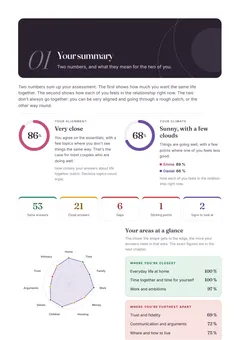
Relationship assessment -20% right now
The complete assessment of your relationship
About a hundred specific questions on money, children, where to live, fidelity... Each of you answers on your own side, or you answer alone if the other isn't ready, and you get a 40-page report that compares the answers, topic by topic.
- 100 questions, together or on your own
- Built on research in couple psychology
- A 40-page PDF report, with charts
Free questions · report Usual price: €9.90 Discounted price: €7.92 for both of you