
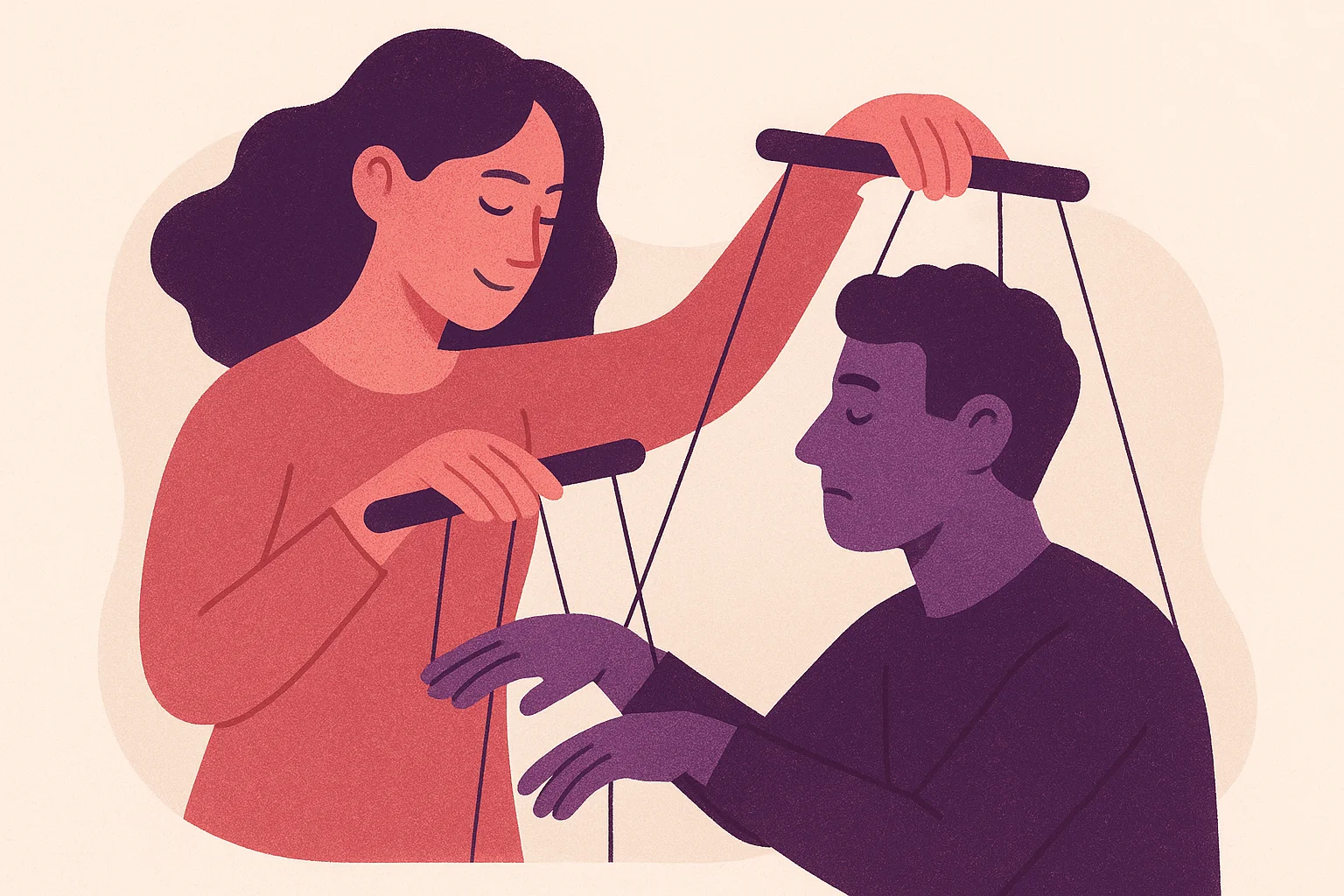
Quick summary
- A narcissist feeds on the image you reflect back at him: he seduces massively, then devalues, then starts again.
- The most reliable sign isn't in him, it's in you: you doubt your memories, your reactions, your worth.
- In public he's flawless. The damage is reserved for private life, which isolates you further.
- It isn't an official diagnosis, and that changes nothing about what you're living: the mechanism matters, not the label.
- You can settle this: concrete checks exist, and a structured test helps you out of the fog.
There's the man everyone else sees: funny, attentive, brilliant in company. And then there's the one you find once the door closes. The one who blows hot and cold, who turns every argument back on you, who makes you doubt your own memory... The gap between the two is so wide that you've stopped mentioning it to anyone. Honestly, who would believe you?
That is exactly what living with a narcissist feels like: permanent doubt, installed by someone else, that you've ended up mistaking for your own. And if you're searching this at 11pm instead of sleeping, it isn't for a definition. It's to find out whether this is what you're living.
So let's take it in order. First, what a narcissistic partner actually is, without jargon and without the horror-film version. Then what it looks like from inside a relationship, day to day, because that's where everything happens. And finally, concrete ways to settle the question. There's a fair chance that by the end of this article, you won't really need anyone to hand you the answer...
Narcissistic partner: what we are talking about
The word is everywhere. So everywhere, in fact, that it has become an insult thrown mid-argument, and the people it hurts most are those living with a real one. So let's put things back in their place.
A narcissist is someone who needs to feel superior in order to stay upright, and who uses the other person as fuel. Not through fits of anger or clumsiness, no: by design. For him, the relationship isn't really a bond between two people. It's a mirror, and it has to reflect him large. As long as you admire him, everything's fine, you're perfect. But the moment you become a real person again, with needs, boundaries and bad days... you turn into a problem to be corrected.
What sets him apart from a simply selfish man
It's a fair question, because selfish men do exist. The difference? A selfish man disappoints you. A narcissist dismantles you. And concretely, it comes down to three things.
| Selfish man | Narcissist | |
|---|---|---|
| Consistency | Predictably difficult, you know what to expect | He alternates the best and the worst, and the alternation is what hooks you |
| The target | He neglects your needs | He attacks your perception: you "never said that", you're "exaggerating", you're "making it up" |
| The audience | Selfish in front of everyone | Charming in company, destructive in private |
The third point does the most damage. That contrast between the public man and the private one isn't a detail: it's a tool. Nobody else sees what you see, so your isolation builds itself, without him having to forbid you anything.
What it looks like in a relationship, day to day
Forget the film monster. Day to day, it looks like small things. So small, in fact, that you feel slightly ashamed of complaining about them.
It looks like competing versions, for instance. You describe an evening, he describes a different one, with such conviction that you end up rereading your own messages to check you're not inventing things. That blurring has a name, gaslighting, and it sits at the heart of the system: someone who controls your reality no longer needs to control you.
It also looks like delayed scenes. Never an outburst in front of your friends, no... The remarks land afterwards, in the car on the way home. "You were talking loudly." "You embarrassed yourself." "Lucky I was there." Little by little, you start dreading evenings out, then avoiding them. And he never even had to forbid them.
Concretely, over an ordinary week, it can look like this:
- a dinner where he cuts across you, then "you're paranoid, everyone had a great evening";
- a favour he did for you brought up three times, while your own thoughtfulness never counts;
- a devastating remark in the car, calmly, with no witnesses;
- two days of icy silence because you saw your friends;
- and one perfect Sunday evening, tender and funny... that makes you doubt everything else.
And then there's your own transformation. You catch yourself rehearsing sentences before speaking to him, apologising by reflex, thinking you're useless when your colleagues think you're solid. When a relationship makes you shrink, the problem isn't your size.
The cycle: idealisation, devaluation, rejection, repeat
A controlling relationship doesn't install itself overnight. It follows a well-documented cycle, in three stages, and knowing it helps enormously to make sense of what you're living.
Idealisation: the beginning that's too perfect
An unreal start: constant messages, declarations far too early, immediate plans, that feeling of having finally met someone who understands you completely... This phase deserves a breakdown of its own, it's exactly love bombing and its three phases. Its purpose: create attachment before your critical mind has had time to do its job.
Devaluation: the thermostat turned down
The gaze that dims, criticism that begins with "it's for your own good", the comparisons, the punishing silences. Rarely a clean switch, either. It's more like a thermostat turned down degree by degree, so slowly that you adapt to the cold without noticing.
Rejection, or the threat of it
He leaves you, or lets you believe he's about to, and there you are fighting to win back someone who mistreats you... The worst part? The moment you genuinely start detaching, the idealisation comes back as if by magic. Promises, tears, the return of the man from the early days. And the cycle starts again, a little shorter and a little more violent than the last. That is exactly why breaking up with a narcissist gets harder to hold each time.
The signs that count in a relationship
You'll find lists of twenty signs everywhere. The problem is that taken one by one, they describe half the couples going through a rough patch. Here instead are the six signals that, together and over time, draw the shape of coercive control. And notice what they have in common: the most reliable ones aren't visible in him, they're visible in you.
- You can no longer describe your relationship: When a friend asks how it's going, you don't know what to say. Too complicated, too much context, "you'd have to know him"... A healthy relationship is easy to describe.
- You doubt your own memory: You reread conversations, you write things down secretly, you ask witnesses to confirm. Think about that for two seconds: nobody does that in a relationship where words are reliable.
- He's never wrong. Ever. In several years, you've never seen him take responsibility for anything. His exes are crazy, his colleagues jealous, his failures sabotaged by others... Guess what you'll become in that story.
- Your worth depends on his mood: One day you're exceptional, three days later you're "the problem". Nothing changed in you between the two. The thermostat decides, not you.
- Your boundaries trigger reprisals: A refusal, a disagreement, an evening without him... and here comes the icy silence, the punishment, or the crisis. Not always loudly, either: cold is his favourite anger, because it leaves no evidence.
- His vocabulary runs in a loop: "You're too sensitive." "You're being dramatic." "Nobody but me would put up with you." These aren't ordinary argument lines: they're the favourite phrases of manipulators, the same ones from one man to the next.
Which leaves the question everyone asks: what if it's just an intense relationship? Good news, the two can be told apart.
Intense, but healthy
- The intensity follows your pace, a "no" costs nothing
- Arguments end, and someone comes back towards you
- Your people keep their place in your life
- You feel bigger inside this relationship
Intense, and controlling
- The intensity imposes its pace, a "no" gets paid for
- Conflicts always end in the same place: your fault
- Your social life has shrunk with no formal ban
- You rehearse sentences before speaking to him
Ticking the right-hand column but the word "narcissist" still feels too big? The word barely matters. A relationship producing those effects is, at minimum, a toxic relationship. And that's more than enough to justify what comes next.
And what if it's her? Men and women facing narcissistic abuse
This whole article is written in the masculine for simplicity, but let's be clear: narcissistic abuse has no gender. The mechanisms are identical. What changes is the packaging.
In a man, control leans more often on authority and open disqualification: those are the typical signs of a narcissistic man. In a woman, it works more readily through guilt, the victim position and emotional control... the faces of the narcissistic woman are better masked, and the men living through it dare even less to speak up, it has to be said.
In both cases, the victim's experience is the same: doubt, exhaustion, isolation. And that strange sense of becoming someone else.
Does he love you? Can he change?
These are the two questions that keep people longest in this kind of relationship. They deserve honest answers, even if they aren't pleasant.
Does he love you?
He needs you, that much is true. And from the inside, that need looks a lot like love... Except he needs you as a function: image regulator, admiration supplier, designated culprit. In fact, the most useful question isn't what he feels, you'll never truly have access to that answer. It's this: does the way he loves you do you good? That one, you can answer on your own.
Can a narcissist change?
A deep narcissistic disorder rarely evolves, and never under the pressure of a romantic ultimatum. The trap isn't hoping for change, mind you. The trap is paying for years the price of a hope that nothing feeds, apart from the cycle restarting. Whatever work he might do on himself is his project. Your protection is yours.
How to know for sure
You won't settle this by turning memories over at 2am, the fog is part of the design. What works is creating simple situations, and observing facts.
The ordinary boundary test
Not an ultimatum. Just a plain "no", the kind any couple absorbs without thinking. For example: "I'm seeing Julie tonight, see you tomorrow." His reaction over the following days is worth every speech in the world. Calm acceptance... or reprisals?
Words against actions, over thirty days
Write his promises down somewhere, with the date. A month later, count what was kept. Coercive control lives on talk, it dies on facts.
The outside view you set aside
Get back in touch with someone you trust and see less since this relationship, and describe one precise scene, factually. Their face will tell you whether what you're describing sounds like "a couple going through a rough patch"...
Need to get out of the fog?
Twenty questions walk through the typical situations of a controlling relationship one by one, and the result puts calm words on what you're living. It isn't a diagnosis: it's a starting point you can actually look at.
Take stock nowFree · No sign-up · Instant result
You have your answer. What now?
First, stop trying to catch him out. I know, it's tempting. But telling him "you're a narcissist" will produce neither confession nor insight, only one more reversal... and you'll come across as the one obsessed with diagnoses. Your clarity is a protection tool, not an argument.
Next, rebuild quietly what the control dismantled: connections, autonomy, reality. See your people again, even briefly. Keep dated written records. Take up an activity that belongs only to you. Every external anchor weakens the mechanism, it's mathematical.
And if you find you can't leave even though you know? That's neither weakness nor misplaced love. It's the normal working of trapped attachment, often amplified by a need for love that has become vital, something this kind of partner detects and feeds very well. It can be worked on... and escaping coercive control is a four-step path, not a leap into the void.
You're not too sensitive. You're not exaggerating. You've just spent too long inside someone else's fog... and you've just taken the first step out of it.
Frequently asked questions about narcissists in relationships
To finish, the questions that come up most often, in short form.
How does a narcissist react when you leave him?
Rarely with indifference, let's be honest. First anger and belittling, sometimes a campaign to turn your shared circle against you. Then, very often, the charm returns: nostalgic messages, promises to change, appearances timed for exactly the moment you start feeling better... That isn't love coming back, it's control renegotiating itself. Preparing for it in advance changes everything.
Is he aware of what he's doing?
Partly, yes. He knows how to aim: the attacks always land on your sensitive spots, never in front of witnesses, which does imply a form of calculation. But he almost never experiences himself as the aggressor. In his internal story, he's the victim. That's why waiting for him to realise leads nowhere, and why the only real question is what you are living. If you're at that point, our "am I with a narcissist" test will help you answer calmly.
How long does it take to recover?
Longer than after an ordinary break-up, and that's not a flaw on your part. It isn't only about grieving a relationship: it's about relearning to trust your own judgement, which takes time. Count in months rather than weeks, with relapses of doubt that are part of the process. Professional support shortens the journey considerably, for example therapy specialising in psychological abuse.
And the children, how do you protect them?
They see far more than we think, even very young, and even when nothing is said in front of them: what they pick up is the tension, the silences and your own state. Three things genuinely help. First, never putting them in the position of referee or confidant in the conflict, that's a weight no child knows how to carry. Next, giving them a trusted adult outside the home, a grandparent, a teacher, a child psychologist, because a fresh pair of eyes protects them from the household's single version of events. Finally, if a separation is coming, keep dated records: in most jurisdictions, psychological abuse is taken into account in custody decisions, but it has to be demonstrated, not just recounted.
Can you report psychological abuse?
Yes. In many countries, coercive control and psychological abuse within a relationship are criminal offences, including between unmarried or separated partners. The real difficulty is evidence: keep written records, medical certificates, statements from people close to you. A victim support organisation or a solicitor will guide you on how to proceed.
Read alsoLove bombing: how to tell real love from manipulation