
Quick summary
- The core criterion: not what the relationship contains, but what it turns you into.
- The 7 reliable signs are measured over time, not over one bad week.
- Toxic doesn't always mean manipulative: two decent people can create a toxic dynamic.
- That difference, mutual dynamic or one person's hold, decides whether it can be fixed.
- A rough patch exhausts you. A toxic relationship shrinks you. It isn't the same thing.
«Toxic relationship». The word is used so widely now that it covers everything: a slightly heated argument, a bitter ex, a disagreement about holidays, boom, toxic! The result is that when you ACTUALLY ask the question about your own relationship, you no longer know what to think. Is it serious? Is it normal? Is it me?
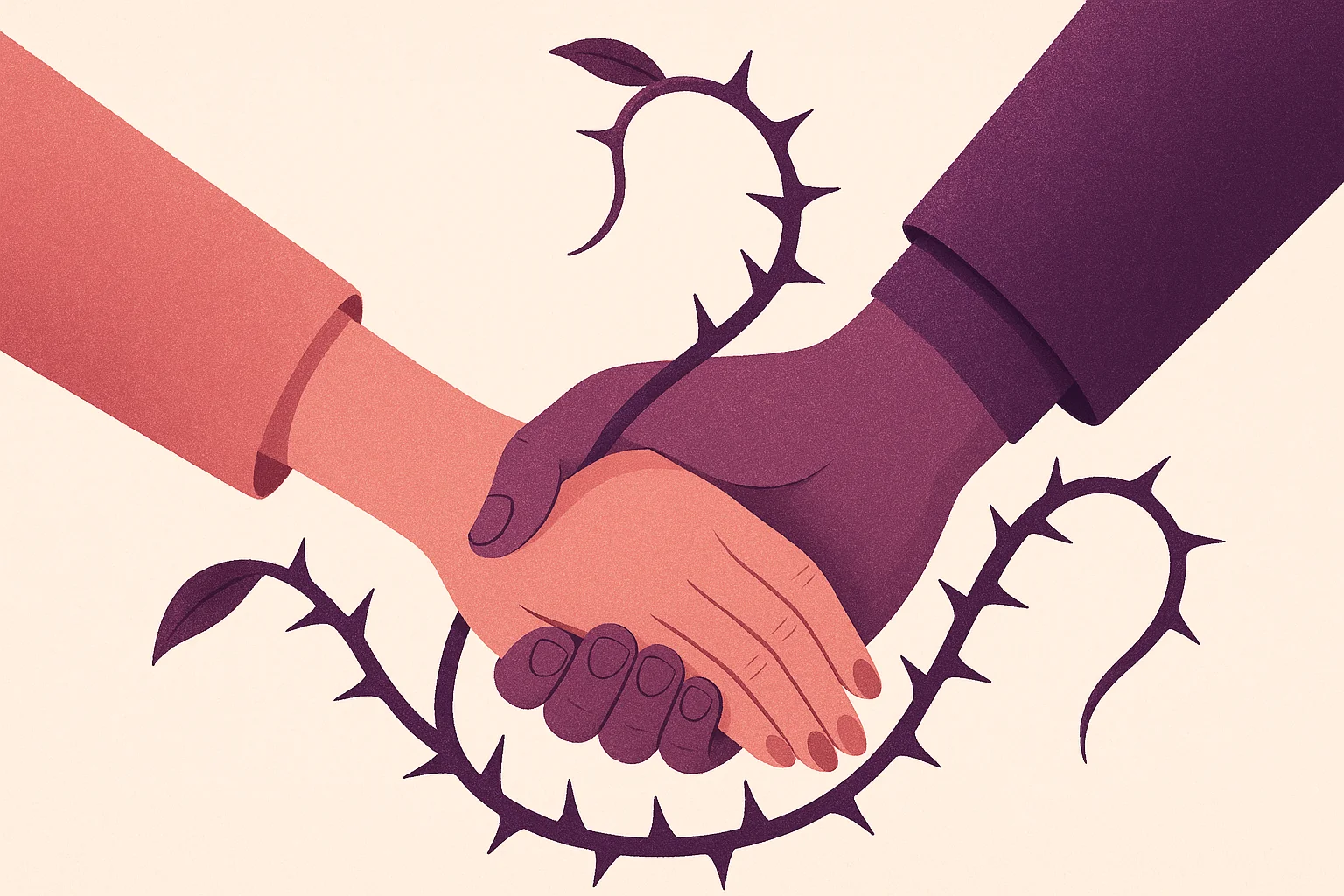
So let's set out the real criterion, the one that puts everything back in order: a relationship is toxic because of what it does to you, not because of what it contains. Every couple has arguments. Differences, grey periods, words that go too far: same. That isn't the question. The question is: what state does this relationship put you in, week after week?
We'll look at it calmly, all the way to the question that matters most: can it be fixed, or not?
The 7 signs of a toxic relationship
None of these signs is judged on an isolated episode, as we said. Look at the trend over several months, and be honest with yourself, that's the only prerequisite.
- You've been doing worse since this relationship: The simplest sign, and the most ignored. Sleep, mood, energy, confidence: compare before and now. A relationship can go through storms; it shouldn't degrade your underlying health.
- Conflicts loop without ever settling anything: The same argument comes back, with the same phrases, the same positions, and none of them leads to a change. Arguing isn't a sign of toxicity. Arguing and changing nothing is.
- You walk on eggshells: You weigh your words, you pick «the right moment», you give up entire subjects to avoid the reaction opposite you. When caution becomes your default mode of communication, something is genuinely wrong.
- The blame counter only runs one way: At the end of every conflict, you're the one apologising. You're the one repairing, the one making the effort. A healthy couple shares the blame roughly evenly over time, not 90/10.
- Your outside life has shrunk: Friends seen less, family kept at a distance, activities abandoned. Whatever the mechanism, reproaches, scenes, or plain exhaustion: if the relationship has dried up the rest of your life, that's a major signal.
- Emotional blackmail is part of the machinery: Love, mood or the other person's presence are conditional on your obedience. «If you loved me, you'd...», punishing silences, threats to leave drawn at every disagreement. Affection has become a currency.
- You no longer recognise yourself: More suspicious, more switched off, harder, or simply smaller. When several people close to you say «you've changed» and it isn't a compliment, listen to them. They see what being inside the relationship stops you seeing.
| The sign | Where it shows up first |
|---|---|
| You've been doing worse since this relationship | Your sleep, your energy, your baseline mood |
| Conflicts loop | The same argument, word for word, for months |
| You walk on eggshells | The time you spend choosing your words |
| The blame counter only runs one way | Who apologises, at the end, every time |
| Your outside life has shrunk | Your diary, your friends, your own projects |
| Emotional blackmail is part of the machinery | What happens when you say no |
| You no longer recognise yourself | The gap between who you were before and now |
Toxic relationship or rough patch? The real difference
This is THE question that makes everyone doubt, because bad periods happen in every couple: a bereavement, a burnout, a birth, a house move. Whole months can be grey without the relationship being toxic. Here's how to tell them apart.
Rough patch
- The crisis has an identifiable cause, often external
- You're both suffering, and you both know it
- The good moments stay genuinely good
- You can talk about it without it exploding every time
- You're still yourself, just tired
Toxic relationship
- The unease has become the climate, not the weather
- The suffering is strangely one-sided
- Even the good moments are under tension
- Talking about it systematically makes things worse
- You shrink, and the people close to you see it
The difference, deep down: a rough patch exhausts you, a toxic relationship transforms you. You come out of a rough patch tired but whole. You come out of a toxic relationship having to remember who you were before.
An important nuance: toxic doesn't always mean manipulative
There are two big families of toxic relationships, they don't have the same prognosis, and that nuance changes everything that follows.
The two-person toxic dynamic
Two people who aren't unkind at all can manufacture, together, a system that damages them: one pursues, the other flees; one explodes, the other shuts down; one person's wounds activate the other's. Nobody is manipulating anybody, and yet everyone suffers. The good news: those dynamics, once both people become aware of them, really can be worked on.
One person's hold
Here the toxicity is no accident: control, guilt-tripping, devaluation and isolation are all organised for the benefit of one person. If the signs you're ticking look like those of the narcissist in love, or the narcissistic manipulator's techniques, you're no longer in an unhappy dynamic: you're in a coercive relationship. And that can't be «fixed» together, since one of the two has no interest in anything changing.
Can it be fixed? And how?
For the two-person toxic dynamic, the answer is yes, on three conditions, not one fewer: that BOTH recognise the problem, without handing each other the whole bill; that BOTH change concrete behaviours, not just intentions; and that a framework exists, a third party, couples therapy, written rules, because toxic habits can't be dismantled bare-handed. If those conditions seem to be met in your case, then saving your relationship becomes a realistic project, to be run seriously, step by step.
For one person's hold... let's not kid ourselves: repair would require the person who benefits from the system to agree to dismantle it. That almost never happens, and certainly not under a romantic ultimatum. In that case the work is no longer «how do I fix the relationship» but «how do I protect myself, then leave». That's a different project, and it starts by no longer doubting what you're living through.
In both cases, one step comes before all the others: getting objective. Coming out of the fog of impressions, laying the facts out flat.
Where exactly does your relationship stand?
A set of questions puts your relationship through the concrete situations in this article: conflicts, balance, freedom, inner state. The result places you calmly, from a couple going through a patch to a couple doing damage.
Place my relationshipFree · No sign-up · Instant result
And if while reading all this a small voice says «I already know, actually», listen to it: we often know the answer long before we dare say it to ourselves. The list of things you should never accept in a relationship can help you set your limits out clearly, in black and white. It's often the first step that counts.
Read alsoNarcissist in love: recognising the hold while you're right inside it