
Quick summary
- The core symptom: your emotional state depends on the other person's signals, hour by hour.
- The 16 symptoms fall into four areas: your head, your relationship, your body, other people.
- Loving hard is not a symptom. Being afraid all the time is.
- The body speaks too: knotted stomach, wrecked sleep, exhaustion from constant vigilance.
- Frequency and suffering make the diagnosis, not one isolated episode.
He hasn't replied in two hours. Objectively, nothing has happened: he's working, living his life, everything is fine. But you have already checked your phone fifteen times, reread your last message to see whether it was clumsy, and built three scenarios, one of which ends with him leaving.
If that scene sounds familiar, you may already have wondered whether you were «too much». Too attached, too anxious, too dependent. The real question is whether your emotional balance depends entirely on someone else, not whether you love too hard. That's emotional dependency, and it has precise symptoms.
We're going to go through them one by one, area by area: what happens in your head, in your relationship, in your body, and with other people. Not to slap a label on you. Just to help you see clearly, because this pattern responds very well to work, once it has been identified.
The core symptom, the one that sums up all the others
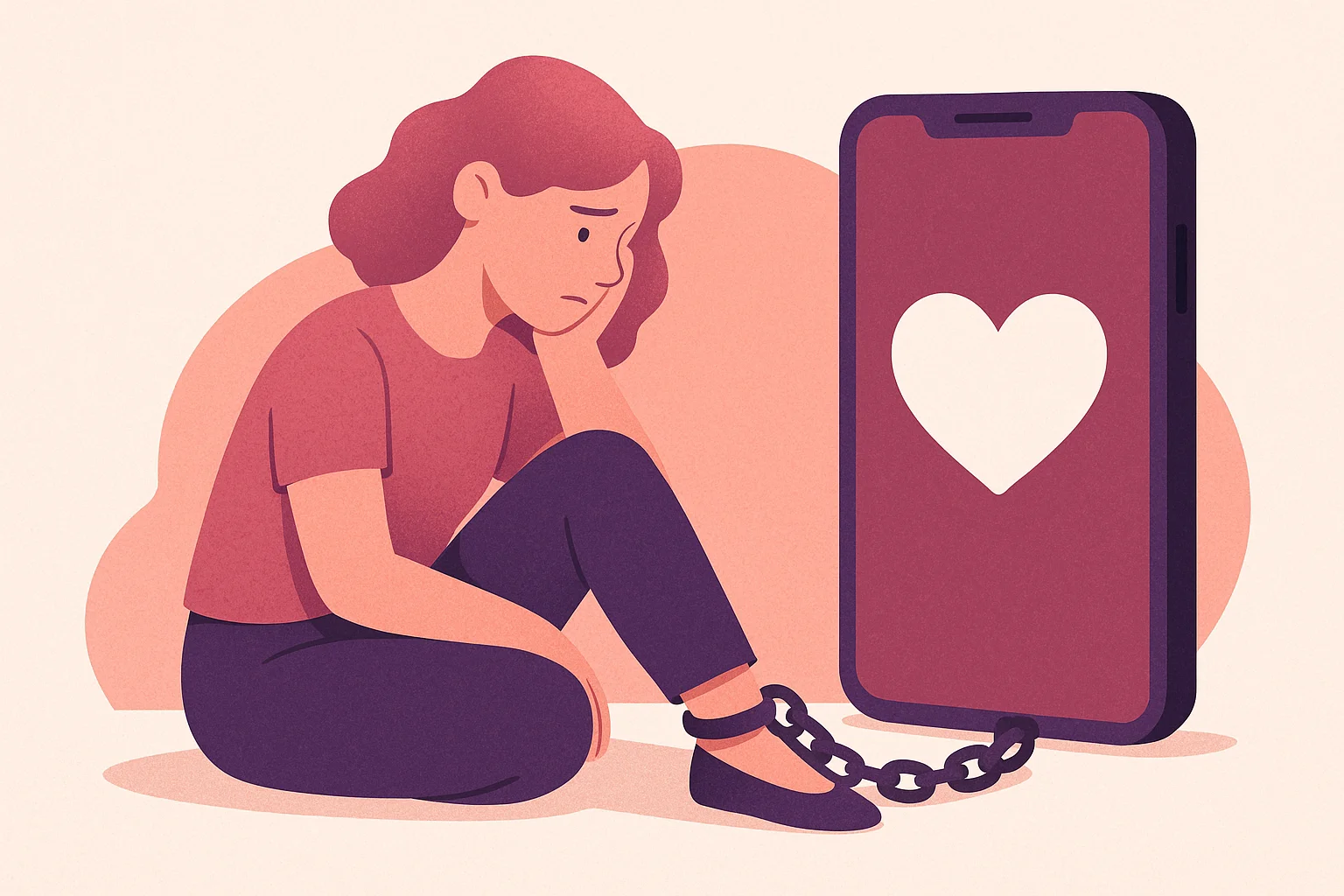
Before the list, you need to understand the basic mechanism, because every symptom flows from it. Emotional dependency is, at bottom, using the other person as an emotional regulator: your calm, your worth, your inner security all come through his signals. One tender message and your day is beautiful. One silence and everything collapses.
The problem isn't being affected by your partner's signals, everyone is! The problem is the amplitude. When someone outside you holds the thermostat of your inner state, you're no longer in a relationship, you're in survival mode. And that is what the following symptoms describe, each in its own way.
| Where it shows up | What it looks like in practice |
|---|---|
| In your head | Constant interpretation, fear of abandonment running in the background |
| In your relationship | Reassurance that never holds, boundaries that never get set |
| In your body | Knotted stomach, sleep gone, relief when the phone buzzes |
| With other people | Friends seen less often, a life filed away behind one person |
In your head (symptoms 1 to 5)
- Fear of abandonment, running in the background: A program running permanently, rather than a worry that passes. A slightly sharp tone, a «we'll see», a distracted look, and your brain jumps to the worst. The most exhausting part is that even the good moments get contaminated: you only half enjoy them, because part of you is already anticipating the end.
- Constant interpretation: You reread the messages, analyse the emojis, compare today's reply time to last week's. Your relationship has become an investigation, and you a full-time detective. Exhausting, and above all endless, because no proof reassures for more than a few hours.
- The repeated need for reassurance: «Do you love me?», «Are we okay?», asked not to open a conversation but to calm anxiety. The answer works like medication, with a short-acting effect. You quickly need another dose.
- Self-worth indexed to him: If he values you, you're worth something. If he's distant, you're worth nothing. Your self-esteem no longer belongs to you: it rises and falls with his mood.
- Being unable to be alone without suffering: Solitude doesn't rest you, it puts you on alert. A weekend without him is no longer time for yourself, it's an ordeal to get through, watch in hand.
In your relationship (symptoms 6 to 10)
- You no longer say no: For fear of disappointing, of creating a chill, of giving him a reason to leave. Your preferences systematically come after his, to the point where sometimes you no longer know what you prefer.
- You erase yourself pre-emptively: You guess his wishes before he says them, defuse conflicts before they exist, swallow complaints before voicing them. From a distance you look «easy to live with». Except that by erasing yourself, you have disappeared.
- Jealousy becomes invasive: Often without a single scene, just discreet monitoring, checked social media, the «who is she?» you regret instantly. Behind it, always the same logic: every person around him is a threat to your emotional survival.
- You stay, even when it hurts: This is the symptom with the heaviest consequences. An average relationship, disappointing, sometimes frankly toxic, and yet the idea of leaving is more frightening than the idea of suffering. Be careful here: this profile attracts precisely the partners who exploit it, more on that below.
- The relationship has eaten everything else: Your projects, your passions, your own evenings: everything has slid into second place, without any conscious decision. One day you realise it has been months since you did anything that didn't involve him.
In your body (symptoms 11 to 13)
We rarely talk about it, which is a shame. Emotional dependency is also a physical matter, because permanent insecurity is chronic stress. In practice:
- The knot in your stomach when he goes quiet: A real physical reaction when he doesn't reply: tight throat, knotted stomach, difficulty concentrating on anything else. Your body treats a late message as a danger.
- Sleep falling apart on doubt-filled nights: The 2am ruminating, waking up to check the phone, the fatigue that piles up and makes the anxiety even harder to manage the next day. A classic vicious circle.
- Exhaustion from constant vigilance: Being on alert non-stop burns an insane amount of energy. If you feel drained for no obvious reason, while your life looks «normal», ask yourself how many hours a day your brain spends monitoring your relationship.
With other people (symptoms 14 to 16)
- Your friendships lie fallow: Lack of love has nothing to do with it: every resource you have has been reallocated to the relationship. The friends from «before» get polite replies and postponed evenings, until they stop suggesting anything.
- You ask everyone to reassure you: Analysing his messages with your best friend, the «do you think he loves me?» on repeat. The people around you become your relationship's emergency service. Generous at first, exhausted in the long run.
- You always pick the same profile: Distant, elusive, lukewarm, and there you are running again. It isn't bad luck: insecurity looks for what it knows. And when the distant partner is also a manipulator, the cocktail becomes genuinely dangerous: the codependent and manipulator duo turns your fear of abandonment into a made-to-measure control tool.
At what point should you do something about it?
Nobody ticks zero boxes, let's be clear. Everyone has reread messages or needed reassurance during a fragile period. So where is the line?
Three criteria make the difference. Frequency: one episode a month is not a pattern, one episode a day is. Suffering: is it costing you serenity, sleep, friendships? And its grip on your choices: is fear deciding in your place what you say, what you accept, what you keep quiet?
If you answer yes to all three, this isn't a character trait to own, it's a pattern to work on. And good news: it really can be worked on, the three-phase exit plan transforms this pattern within a few months, with exercises to back it up. The first step, often, is simply to put words on what is happening to you.
Do you recognise yourself in several of these symptoms?
A set of questions goes back over every situation in this article, in everyday-life terms, and tells you where you stand: healthy attachment, temporary fragility or real emotional dependency. No judgement, and for your eyes only.
Assess my situationFree · No sign-up · Instant result
Frequently asked questions about the symptoms of emotional dependency
Three short answers to the questions that come up most.
Is emotional dependency an illness?
No, not in the strict sense: it isn't an official diagnosis in psychiatric classifications. It's a mode of emotional functioning, often rooted in your attachment history, which can however accompany genuine disorders (anxiety, depression) when it settles in. In other words: not a medical label, but very real suffering, and one that responds well to treatment.
Can you be emotionally dependent and happy in a relationship?
In phases, yes, especially with a stable, reassuring partner. But the foundation stays fragile: your serenity depends on the other person's behaviour, not on you. At the first patch of turbulence, some distance, a conflict, a doubt, the symptoms come back. That's why the real work happens on your inner security, not on choosing the «right» partner.
Are men affected too?
Completely, and probably more than people think: they seek help less, talk about it less, and their symptoms sometimes take other forms, controlling jealousy, anger, or over-investment in the relationship. The subject has its own codes, and we go through them in emotional dependency in men.
Read alsoEmotional dependency: when loving becomes a vital need