
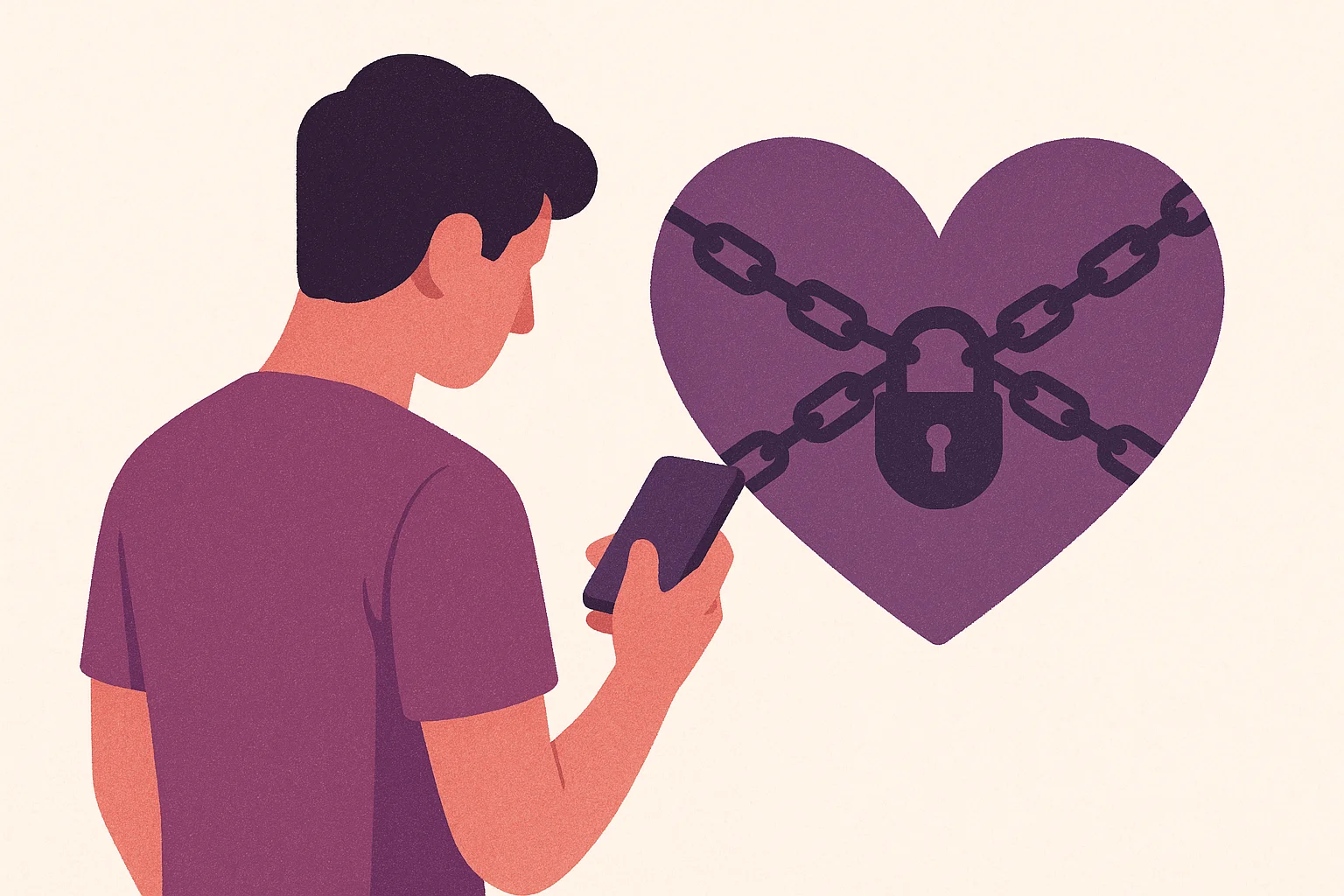
Quick summary
- Male emotional dependency doesn't look like the cliché: it disguises itself.
- Its favourite masks: controlling jealousy, anger, over-investment, back-to-back relationships.
- The underlying mechanism is the same as in women: the other person regulates your inner state.
- The taboo makes everything worse: a man «in need», socially, isn't something you say.
- It can be worked on the same way as in women, provided you first agree to name it.
When you say «emotional dependency», everyone pictures the same scene: someone pleading, clinging, sending fifteen messages. And since most men don't recognise themselves in that image, they conclude it doesn't apply to them. Big mistake.
Male emotional dependency exists, it's widespread, and it wears masks nobody identifies as emotional need. It looks like jealousy that controls, like anger that explodes over nothing, like the over-investment of the perfect guy who does everything at home, or like that phenomenon everyone knows without naming it: the man who is NEVER single for more than three weeks.
So here is emotional dependency in its male version, with its real faces. If you're a man reading this, brace yourself, there's a good chance it stings a bit. And if you're a woman recognising your partner, the end of the article is for you too.
Why we never see it in men
There are two reasons for that, one social and one mechanical.
The social one first: boys are taught not to be «in need». Crying over a girl, admitting you're afraid of losing someone, saying «I need you», all of that costs a lot in perceived masculinity. As a result, male emotional need learns very early to disguise itself as something else. It doesn't disappear. It puts on makeup.
Then the mechanical one: emotional dependency stays the same under the disguise, a system where the other person regulates your emotional state. In many women, anxiety expresses itself as a visible demand for reassurance. In many men it expresses itself as control: if I can't plead, I'll secure. Monitor. Lock down. It's the same engine with different bodywork. And that bodywork does much more damage around it.
The 8 faces of male emotional dependency
- Controlling jealousy: He checks, he questions, he suspects. The phone looked at «by chance», the «was he there?», the girls' nights that become a problem. Behind the control, there's always the terror of losing, which doesn't know how to say itself any other way.
- Anger as a lightning rod: Many emotionally dependent men know only one outgoing emotion: irritation. She comes home late, he explodes. She forgets to let him know, he sulks for two days. Translation: «I was scared, and I don't know how to say it». The anger is just fear that has found a more masculine way out.
- The over-investment of the perfect guy: This one is counter-intuitive. He does everything: the shopping, the presents, the plans, the repairs. Generous? On the surface. Underneath, it's an implicit contract: «I'm making myself indispensable so you can't leave». The problem is that this kind of generosity always expects something back.
- Never single: The great classic: back-to-back relationships, the next one starting before the previous one ends, total inability to be alone for more than a month. Behind the chaining, there is mostly the fear of being left alone with himself. And as long as he keeps chaining, he never does the work that would fix the problem.
- Remote-controlled mood: She's tender, his day is good. She's distant, his day is ruined. His colleagues can read it on his face: «trouble with your girlfriend?» When your mood depends that much on hers, you're no longer the one setting it.
- Friendships left fallow: The Thursday football abandoned, the friends «from before», the lads' holiday now unthinkable. Not because she forbids it, careful! Because moving away from her, even for two days, costs too much in anxiety. So he stays, and he tells himself it's love.
- Permanent sacrifice, silently accounted for: He says yes to everything, forgets himself entirely, and keeps the books without knowing it. The day it overflows, it comes out all at once: «I did EVERYTHING for you!» Devotion that expects a return always ends up claiming it.
- Fear of abandonment disguised as demands: He doesn't plead, he demands. Presence, accounts, proof. It looks like authority, but underneath it's panic. And it exhausts the other person as much as plaintive neediness, only worse.
| The mask | What people around him see | What's underneath |
|---|---|---|
| Controlling jealousy | A possessive guy | The terror of not mattering enough |
| Anger as a lightning rod | A difficult temperament | A pain with no other way out |
| The perfect guy | An irreproachable partner | A worth that has to be bought back daily |
| Never single | Someone lucky in love | The emptiness he never wants to cross |
| Friendships left fallow | A settled man, that's normal | An entire life filed behind one person |
| Accounted-for sacrifice | A devoted partner | A debt he hopes to be repaid |
| Remote-controlled mood | Someone moody | An inner state piloted from outside |
| Fear disguised as demands | An authoritarian man | Panic disguised as authority |
What it does to the relationship (the vicious circle)
The tragedy of male emotional dependency is that it manufactures what it dreads. And it always unfolds in the same order.
He grips too tightly, out of fear of losing. She suffocates, so she takes some distance, simply to breathe. He feels the distance, panics, and grips even tighter. Jealousy up, control up, reproaches up. She moves further away. And one day she leaves, not because she didn't love him, but because you can't love while holding your breath.
The worst part? That departure «confirms» his original belief: people always end up abandoning me. And off he goes again, with the next one, worse. That's the circle the classic symptoms of emotional need feed in silence, as long as nobody names it.
Getting out of it, the male version
The underlying method is the same for everyone: the 12 exercises to overcome emotional dependency work just as well for men: stabilise, reclaim your life, consolidate. But there are three male specifics that change the game.
Name it, first
You can't work on a problem you call «she annoys me». The first victory is translating: behind my jealousy there's fear. Behind my anger there's need. It costs something, the first time, but it changes everything: you can work on fear, not on «she annoys me».
Tell ONE friend
Not ten, not on social media: one, the most reliable. Men massively underestimate what that unlocks, because they expect to be judged, and half the time they get back a «mate, me too».
A therapist isn't a defeat
A therapist is a coach. You'd hire a coach for sport or a mechanic for the car, wouldn't you? Attachment wounds are the same: there are people whose job it is, and the results are spectacular with men, because they arrive with twenty years of unspoken words to catch up on.
A word if you're the partner who recognised her man in this article: you can't do the work for him, and reassuring him more and more heals nothing, it feeds the system. What you can do is name what you see once, clearly and without contempt, then encourage him to go and get help. The rest belongs to him.
Take stock, right now, in five minutes
A set of questions assesses your attachment style through concrete situations, jealousy, control, emptiness, mood. Nobody will know, and you'll finally know where you stand.
Check where I standFree · No sign-up · Instant result
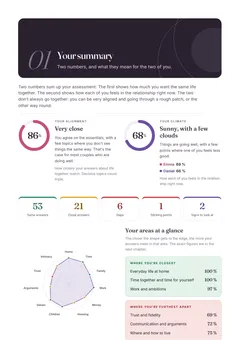
Relationship assessment -20% right now
The complete assessment of your relationship
About a hundred specific questions on money, children, where to live, fidelity... Each of you answers on your own side, or you answer alone if the other isn't ready, and you get a 40-page report that compares the answers, topic by topic.
- 100 questions, together or on your own
- Built on research in couple psychology
- A 40-page PDF report, with charts
Free questions · report Usual price: €9.90 Discounted price: €7.92 for both of you