

Quick summary
- Arthur Aron's experiment (1997): 36 increasingly intimate questions plus 4 minutes of eye contact.
- The mechanism: reciprocal, progressive self-disclosure, ingredient number one of closeness.
- Three sets of 12 questions, to be done in order: the gradation is what does the work.
- It works on two strangers, and surprisingly well on established couples.
- No, it isn't magic: it creates the conditions of intimacy, not love on demand.
The story is true, and it's irresistible. In 1997, the American psychologist Arthur Aron brought pairs of strangers into his laboratory. The instruction: ask each other 36 questions, in order, increasingly personal, then look into each other's eyes for four minutes, without speaking. The result: record closeness between complete strangers, and, this is what the legend mostly remembers, two participants who ended up marrying.
The experiment slept in the scientific journals until 2015, when an essayist wrote in the New York Times that she had tried it on a date, and fallen in love. Since then, the «36 questions» have gone around the world. And contrary to what people think, it isn't a gimmick: the mechanism behind it is solid, documented, and it also works on established couples.
Here are the 36 questions in full, sorted into three sets, the exact protocol, and what the experiment does not promise.
Why 36 questions can create intimacy
The secret isn't in the questions themselves, it's in their ARCHITECTURE. Aron built his list on a simple principle: intimacy is born of reciprocal and progressive self-disclosure. Translation: I show you something of me, you show me something of you, and we go up a step with every exchange.
That's exactly what happens naturally when two people fall in love, except it takes weeks. The protocol compresses the process into 90 minutes, by forcing two things ordinary conversation avoids: strict reciprocity (both answer everything, no interviewer and interviewee) and gradation (impossible to jump to deep confidences without going through the levels).
And the four minutes of eye contact? They're not decorative: holding someone's gaze is pure vulnerability, without words to hide behind. After 36 questions of warm-up, those four minutes seal something. Most people who've done it still talk about it years later.
| The set | Its role in the protocol |
|---|---|
| Set 1 | Opening gently, on subjects you can decline without awkwardness |
| Set 2 | One step up: memories, regrets, what matters |
| Set 3 | The most exposed, made possible by the two previous sets |
Set 1: getting to know each other, properly (questions 1 to 12)
The first level looks harmless, but it isn't. Every question already contains a small door towards the intimate. Answer honestly, not brilliantly!
- Given the choice of anyone in the world, whom would you want as a dinner guest?
- Would you like to be famous? In what way?
- Before making a telephone call, do you ever rehearse what you're going to say? Why?
- What would constitute a perfect day for you?
- When did you last sing to yourself? And to someone else?
- If you could live to 90 and keep either the mind or the body of a thirty-year-old for the last 60 years of your life, which would you choose?
- Do you have a secret hunch about how you will die?
- Name three things you and I appear to have in common.
- For what in your life do you feel most grateful?
- If you could change anything about the way you were raised, what would it be?
- Take four minutes and tell me your life story in as much detail as possible.
- If you could wake up tomorrow having gained any one quality or ability, what would it be?
Set 2: getting personal (questions 13 to 24)
Second level: the fears, the memories, what matters. This is where the conversation changes texture, you'll feel it happen.
- If a crystal ball could tell you the truth about yourself, your life, the future or anything else, what would you want to know?
- Is there something you've dreamed of doing for a long time? Why haven't you done it?
- What is the greatest accomplishment of your life?
- What do you value most in a friendship?
- What is your most treasured memory?
- And your most terrible memory?
- If you knew that in one year you would die suddenly, would you change anything about the way you're living? Why?
- What does friendship mean to you?
- What roles do love and affection play in your life?
- Taking turns, share five positive characteristics you see in me.
- How close and warm is your family? Do you feel your childhood was happier than most other people's?
- How do you feel about your relationship with your mother?
Set 3: shared vulnerability (questions 25 to 36)
The last level, the strongest. Notice the shift: many of the questions now talk about «we», live. That's deliberate, and that's where everything is decided.
- Make three true «we» statements each. For instance: «we are both in this room feeling...»
- Complete this sentence: «I wish I had someone with whom I could share...»
- If you were going to become a close friend of mine, tell me what would be important for me to know.
- Tell me what you already like about me: be very honest, say things you might not say to someone you've just met.
- Share an embarrassing moment from your life.
- When did you last cry in front of another person? And by yourself?
- Tell me something that you like about me already.
- What, if anything, is too serious to be joked about?
- If you were to die this evening with no chance of speaking to anyone, what would you most regret not having told someone? Why haven't you told them yet?
- Your house catches fire, your loved ones and pets are safe: you can save ONE object. Which one, and why?
- Of all the people in your family, whose death would you find most disturbing? Why?
- Share a personal problem and ask the other person how they would handle it. Then ask them to tell you, honestly, how your way of talking about it made them feel.
And now, if you're playing to the end: four minutes of eye contact, in silence. Set a timer, nobody cheats. It's long, it's intense, and that's exactly the point.
The exact protocol, and who it works for
The rules of the game, as the study set them: in order, no skipping; each person answers each question, alternating who starts; take as long as it takes, generally 45 to 90 minutes; phones elsewhere, obviously, and the four minutes of eye contact to close, for those who dare.
Who for? Three uses, from the most obvious to the cleverest. On a date, first or third: it's the ultimate conversation accelerator, a thousand times better than a dinner of small talk. In a new relationship, to check there's substance behind the spark. And the most underestimated: in an established couple. Aron himself showed the protocol works between long-term partners. Ten years of living together, and question 33 will still catch you exactly the same way. Many couples come out of it with conversations they'd never had.
By the way, if you're an established couple and you enjoy the exercise, that's exactly the philosophy of the questions to get to know each other better, in the regular-ritual version rather than the one big night.
What the 36 questions do NOT do (let's be straight)
Let's stay honest, because the myth damages the tool. No, the 36 questions don't manufacture love on demand. Aron's study wasn't aiming to create couples: it was aiming to generate CLOSENESS in a laboratory, and it does that remarkably well. The married couple from the legend? Real, but anecdotal: nobody counted how many pairs didn't fall in love.
What the protocol actually does: it creates the conditions of intimacy, reciprocal vulnerability, total attention, unhurried time. Conditions our dates today, between two notifications, almost never assemble. If the spark is possible between you two, this framework gives it every chance. If it isn't, you'll have spent an evening of rare depth, and that's already something!
Which leaves the next question, the one everyone asks on the way home: what we felt, was that the atmosphere... or the start of something?
After the 36 questions, how compatible are you?
The experiment creates closeness; compatibility, on the other hand, can be measured. A set of questions cross-checks your visions, your rhythms and your values, and tells you where your duo is solid, and where it will rub.
Measure our compatibilityFree · No sign-up · To do as a pair
And if the full protocol intimidates you for a first date, start lighter: the questions to ask your crush make an excellent warm-up. The 36 can wait for the third date. They lose nothing by waiting, believe me.
Read also60 questions to get to know each other better, even if you think you know everything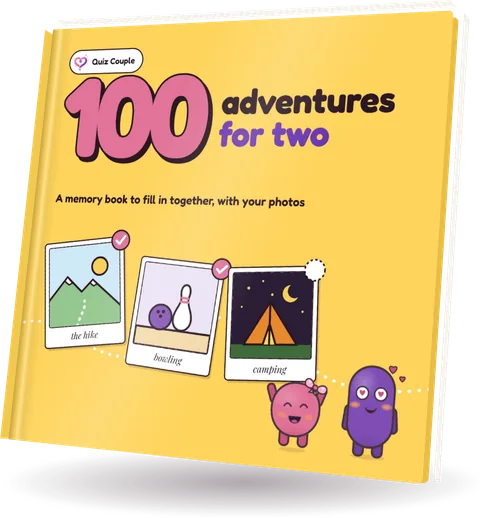
The Quiz Couple book
100 Adventures for Two
The book you fill in together: one adventure per page, and your memories inside.
See the bookThe perfect Christmas gift!