

Quick summary
- For many men attraction arrives fast but feelings build slowly, over weeks or months.
- The real tipping point is not a realisation but an absence: being apart starts to feel uncomfortable.
- Six stages come back regularly, from attraction to the urge to make plans.
- What speeds it up: shared vulnerability, repeated moments, and feeling useful.
- What blocks it: pressure, ambiguity, and an avoidant attachment style that confuses closeness with losing freedom.
- The reliable signs are behavioural changes in daily life, not declarations.
The answer fits in one sentence: for most men, feelings do not arrive as love at first sight but as an accumulation of shared moments that eventually create an absence. That is not less romantic, it is just slower, and above all it stays invisible from the outside for a long time.
One thing needs saying immediately, otherwise this article is useless: there is no universal male blueprint. Attachment research shows far bigger differences between two men than between men and women on average. What follows are frequent patterns, not a law.
That said, these patterns come up often enough to be useful. Especially if you are currently wondering whether he feels something… or is simply there because it is pleasant.
The real order in which it happens
For most men the sequence looks like this: fast attraction, curious interest, comfort, habit, absence, attachment. The absence is the tipping point. Until it hurts to be apart, there is pleasure but not yet feeling.
This is why many women feel that "nothing is happening" for weeks, and then that everything changes at once. Except nothing changed at once! Something changed slowly… and it became visible at once.
The 6 stages, in order
Attraction: fast, often immediate, and not necessarily tied to anything deep. It is the most visible stage and the least predictive: plenty of men feel it without it leading anywhere.
Curiosity: he starts wanting to know. Not out of politeness: he retains what you say and brings it back up three days later. This is the first stage that really counts, because it takes effort.
Comfort: he relaxes. He dares to be tired, grumpy, ridiculous in front of you. Many men were taught not to show those states, so showing them is a strong signal even when it looks nothing like romance.
Habit: you enter his automatic behaviour. He includes you in sentences without thinking, he tells you about his day before knowing why. This is the quietest stage and the most decisive.
Absence: you are not there and something is off. That is the real tipping point, and it is usually where a man realises he cares about someone. Often slightly after everyone around him had already noticed.
Planning: he talks about next month, about summer, about a friend you should meet. By this stage the feelings are in place, whether he has named them or not.
The classic trap is looking for stage 6 signs while the person is at stage 3. That is not indifference, it is a difference in pace!
What speeds it up, what blocks it
What speeds it up: shared vulnerability first: a man who tells you something he does not tell anyone else jumps three stages at once. Repeated moments next, because habit is built by frequency, not intensity. And feeling useful, which for many men remains a way of loving before they can say it.
What blocks it: pressure, obviously: asking where the feelings stand at stage 3 often sends them back to stage 2. Ambiguity too, when nobody knows what this relationship is, because ambiguity stops habit from forming.
And above all, there are those for whom closeness triggers a withdrawal reflex. That is not bad faith: it is a way of relating that shows up very early and that can be worked on. Understanding your own attachment style often explains a man's behaviour far better than any theory about men in general.
The signs that do not lie
Forget declarations! Some men say "I love you" at stage 1 and others at stage 6. Watch what changes in daily life instead…
He tells you useless things: a pointless anecdote from his day. This is the most underrated sign: we only share the mundane with people we have integrated.
He changes his plans without making it a thing: not grand sacrifices, small silent trade-offs.
He introduces you to his world: a friend, a brother, a colleague. That has a social cost, so it is rarely free.
He remembers: a first name, a medical appointment, a story you told once.
Those signs show up once he has settled in. Right at the start, it shows somewhere else, on his body: his hands, his mouth and his eyes give him away long before he admits it to himself.
What actually counts
- He includes you in his sentences without thinking, in the future as much as the past.
- He shows you his unflattering states: tired, sulking, ill, unreasonable.
- He retains details you only mentioned once.
- He reaches out with nothing to gain, on a Tuesday at 3pm, for no occasion.
What tells you nothing
- How fast he replies, which mostly tells you how busy he is.
- Compliments about your looks, present from stage 1 and sometimes leading nowhere.
- Jealousy, which is about his own insecurity, not about your place.
- Sexual intensity in the first weeks, which has never predicted attachment.
Be careful not to confuse attachment that is building with intensity that overwhelms. An avalanche of declarations and gifts from week two looks like very strong feelings, but it is often the signature of love bombing, which follows the opposite logic: give everything very fast to create dependency, then withdraw.
Three false beliefs that waste time
"If he says nothing, he feels nothing." Many men lack the vocabulary, the habit, or carry a very concrete fear of being vulnerable. Silence is not information about the feelings, it is information about the ability to voice them.
"Make him jealous and it will speed things up." That produces agitation, not attachment. Agitation fades in three days; attachment is built by quiet repetition.
"If he were the one, it would be obvious." For some yes, for many no. Doubt at the start is ordinary and says nothing about what follows. If the question runs the other way, about what you feel, a questionnaire about what you actually feel sometimes helps more than a night spent turning it over.
The questions that keep coming up
How long does it take a man to fall in love?
The ranges vary enormously between people. What comes up most often is a few weeks for comfort, two to four months for the absence. A man who "knows" after three days? He is generally confusing attraction with feeling.
How can I tell whether he feels something without asking?
By watching what he does when there is nothing to gain: a message for no reason, a favour done with no audience. If the doubt persists and he says nothing, there is a questionnaire on the signs of undeclared attachment that lists the concrete clues.
Can feelings develop after friendship?
Yes, and it is one of the most solid routes, because stages 2, 3 and 4 have already been cleared. What is missing is the tipping point, and it is often triggered by an absence.
What if I do not know what to ask him to move forward?
The conversations that move things are almost never "where do we stand". Starting from an open question about what he wants from a relationship opens far more than the direct demand, which puts him in the position of answering for himself.
Where the feelings show
Feelings in a man rarely appear where you look for them… Not in the words, not in the grand gestures, but in becoming a habit, and then an absence.
If you have got as far as counting the signs, the real question may not be where he stands, but whether the pace he sets suits you. Those are two different questions, and the second one is entirely yours.
Relationship assessment -20% right now
The complete assessment of your relationship
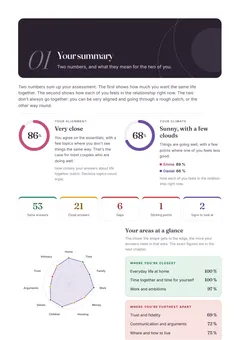
About a hundred specific questions on money, children, where to live, fidelity... Each of you answers on your own side, or you answer alone if the other isn't ready, and you get a 40-page report that compares the answers, topic by topic.
- 100 questions, together or on your own
- Built on research in couple psychology
- A 40-page PDF report, with charts
Free questions · report Usual price: €9.90 Discounted price: €7.92 for both of you