Quick summary
- Maria Skłodowska and Pierre Curie met in Paris in 1894 and married in July 1895.
- No white dress and no rings: a dark blue outfit she later wore in the lab, and two bicycles for the honeymoon.
- Together, they discovered polonium and radium in 1898 and won the Nobel Prize in Physics in 1903.
- After Pierre died in April 1906, Marie kept a diary addressed to him and took over his course at the Sorbonne.
Most people know Marie Curie for her two Nobel Prizes. Fewer know that she lived a real love story with Pierre Curie, one that lasted a little over ten years and ended all at once, in 1906, on a street in Paris.
They did everything together, work included. And when Pierre died, Marie kept talking to him... in a diary she wrote to him.
How Marie and Pierre met
In 1891, Maria Skłodowska left Warsaw to study in Paris, at the Sorbonne.
In the spring of 1894, she was looking for a lab for a study on the magnetism of steel. A Polish professor visiting Paris, Józef Kowalski, introduced her to someone who might help: Pierre Curie, a physicist eight years older than her, who taught at the Paris School of Industrial Physics and Chemistry.
That summer, Maria went home to Poland for the holidays, without knowing whether she would come back to France. Pierre wrote to her, several times, to convince her to come back and do her doctorate in Paris.
"... passer la vie l'un près de l'autre, hypnotisés dans nos rêves : votre rêve patriotique, notre rêve humanitaire et notre rêve scientifique." (... to spend our lives near each other, hypnotized by our dreams: your patriotic dream, our humanitarian dream and our scientific dream.)
Pierre Curie to Maria Skłodowska, summer 1894
She came back to Paris in the fall. They got married the following summer.
A wedding with no white dress
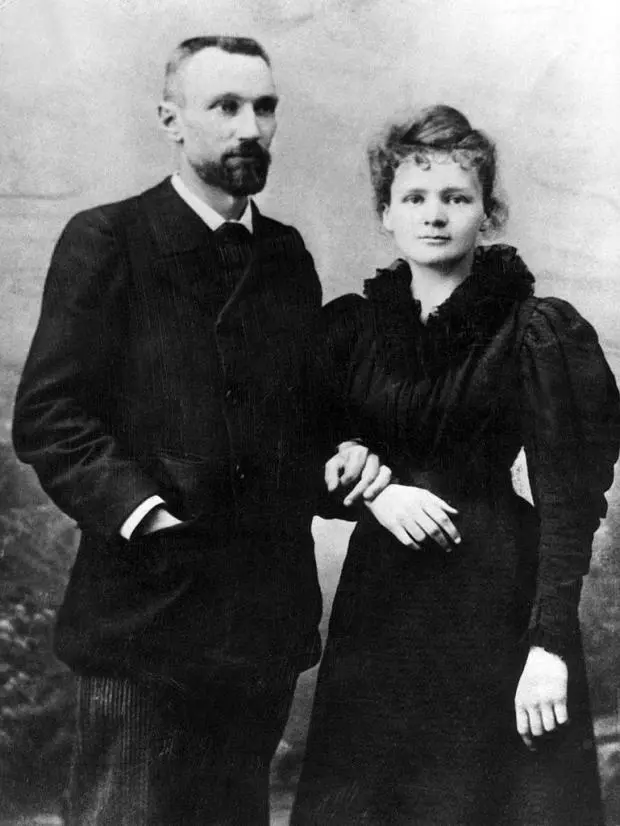
The wedding took place on July 26, 1895, at the town hall of Sceaux, just outside Paris. No church, no rings: a civil wedding, with family and a few friends.
No white dress either. Marie chose a simple dark blue outfit, something she could wear again every day. And that's exactly what she did: she wore it in the lab for years afterwards.
Radium, a discovery made together
For her thesis, Marie picked a brand-new subject: the rays given off by uranium, discovered by Henri Becquerel in 1896. Measuring different minerals, she noticed that some gave off far more than uranium alone could explain. So there had to be something else in them.
Pierre found the lead so promising that he set his own research aside, on crystals, to work with her. In 1898, they announced two new elements: polonium in July, named after Marie's native Poland, then radium in December.
The Curies in numbers
- 11years of marriage, or almost
- 2elements discovered together in 1898
- 5Nobel Prizes in the Curie family
- 1stwoman professor at the Sorbonne: Marie, in 1908
In the meantime, their first daughter, Irène, was born in September 1897. They worked in a damp shed at the School of Physics and Chemistry, and Marie later talked about the very happy working days they spent there, in spite of everything.
The 1903 Nobel Prize, and Pierre stepping in
In 1903, the French scientists who put names forward for the Nobel Prize in Physics nominated Henri Becquerel and Pierre Curie. Marie wasn't on the list.
Pierre heard about it from a member of the Swedish Academy, and he wrote back: if he was being considered for the prize, he wanted it to be together with Madame Curie, for their joint research. In the end she was awarded the prize with them, and became the first woman to win a Nobel Prize.
That says a lot about their relationship. Pierre treated her as an equal, at a time when a woman scientist was easily taken for her husband's assistant.
April 19, 1906
That Thursday, it was pouring with rain in Paris. Pierre was hurrying across a street near the Pont-Neuf when he was run over by a horse-drawn wagon loaded with military uniforms. He was killed instantly. He was 46.
Marie was 38, with two daughters: Irène, 8, and Ève, 16 months old.
Eleven days later, she started a diary written directly to Pierre, addressing him as "tu", the way you speak to someone close. In it, she wrote that she had slipped a photo of herself into his coffin: the picture of the woman he had chosen as his companion. Then she told him about her days, what people were offering her, what she felt. In May, she wrote to him that she had been offered his chair at the Sorbonne, and that she no longer loved the sun or the flowers.
Together in the Panthéon
In 1911, Marie won a second Nobel Prize on her own, this time in chemistry. She died in 1934 and was buried in Sceaux, next to Pierre.
In 1995, their remains were moved together to the Panthéon in Paris. Marie was the first woman to be buried there for her own achievements.
Their daughter Irène followed the same path, by the way. With her husband, Frédéric Joliot, she won the Nobel Prize in Chemistry in 1935. Another couple of researchers!
Read alsoMarie Antoinette and Fersen: their censored letters read with X-raysRead alsoJuliette Drouet and Victor Hugo: 50 years of love and 22,000 lettersSources: Institut Curie, pages on the history of Pierre and Marie Curie (curie.fr, in French); American Institute of Physics, "Marie Curie and the Science of Radioactivity" (see the exhibit); PSL University, virtual exhibition "Marie Curie, 1867-1934" (explore.psl.eu).
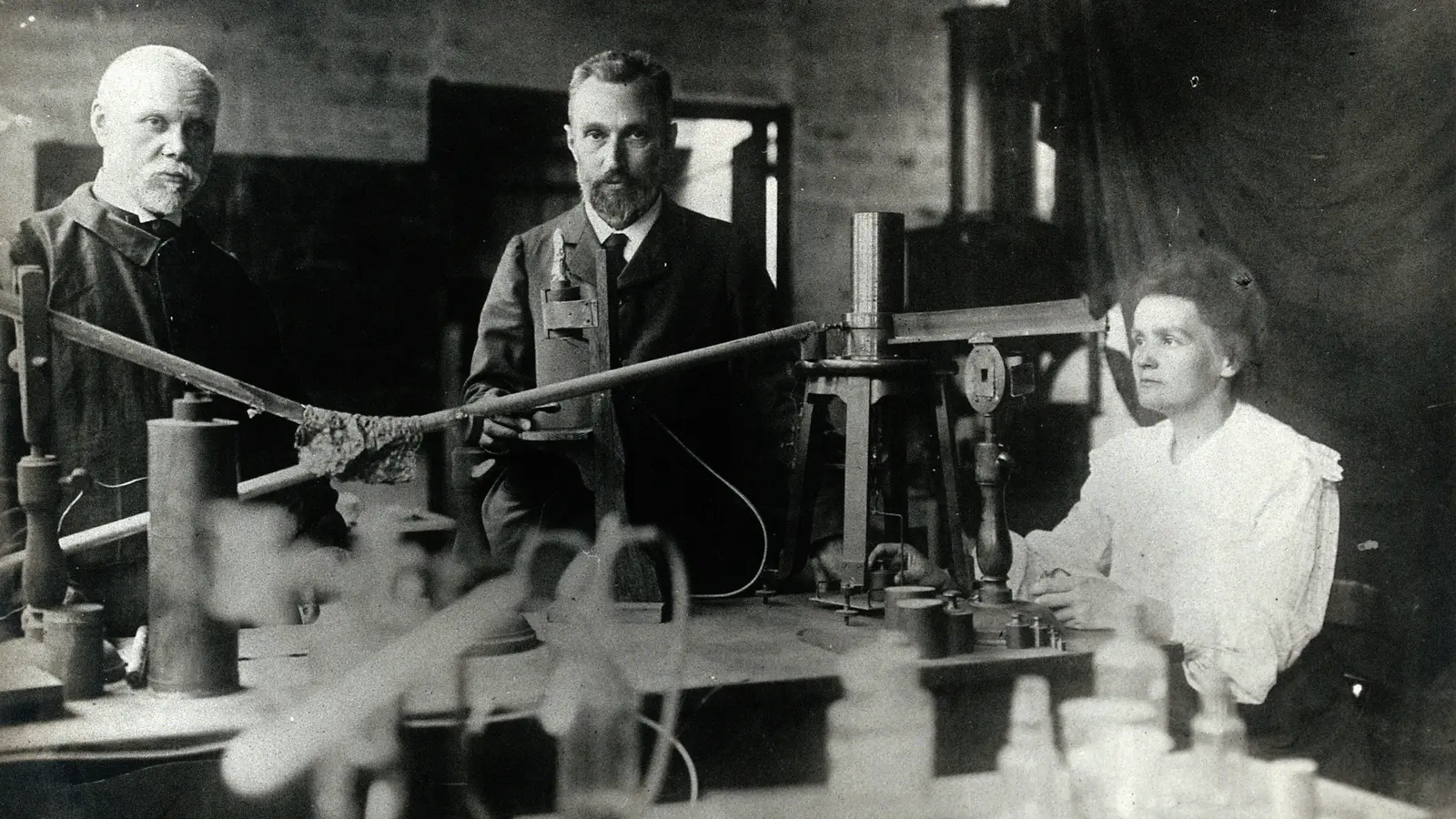
Images: Pierre and Marie Curie in their laboratory, photograph, Wellcome Collection, CC BY 4.0, cropped; Pierre and Marie Curie in 1895, photograph, public domain.
Relationship assessment -20% right now
The complete assessment of your relationship
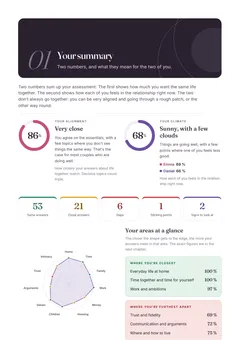
About a hundred specific questions on money, children, where to live, fidelity... Each of you answers on your own side, or you answer alone if the other isn't ready, and you get a full report that compares the answers, topic by topic.
- 100 questions, together or on your own
- Built on research in couple psychology
- A full PDF report, with charts
Free questions · report Usual price: €9.90 Discounted price: €7.92 for both of you