
Quick summary
- Juliette Drouet, an actress, met Victor Hugo in January 1833. He was married, with four children.
- From 1839, she gave up the stage and lived almost in seclusion: Hugo didn't allow her to go out without him.
- She wrote him about 22,000 letters between 1833 and 1883. Most of them are at the National Library of France.
- In December 1851, she helped him escape after Louis-Napoléon Bonaparte's coup, then followed him into exile until 1870.
For fifty years, Juliette Drouet wrote to Victor Hugo almost every day, often several times a day. All in all, that's about 22,000 letters.
She was never his wife. For years, she lived almost shut away for him, and the day Hugo had to flee France... she was the one who saved his life.
An actress and a poet
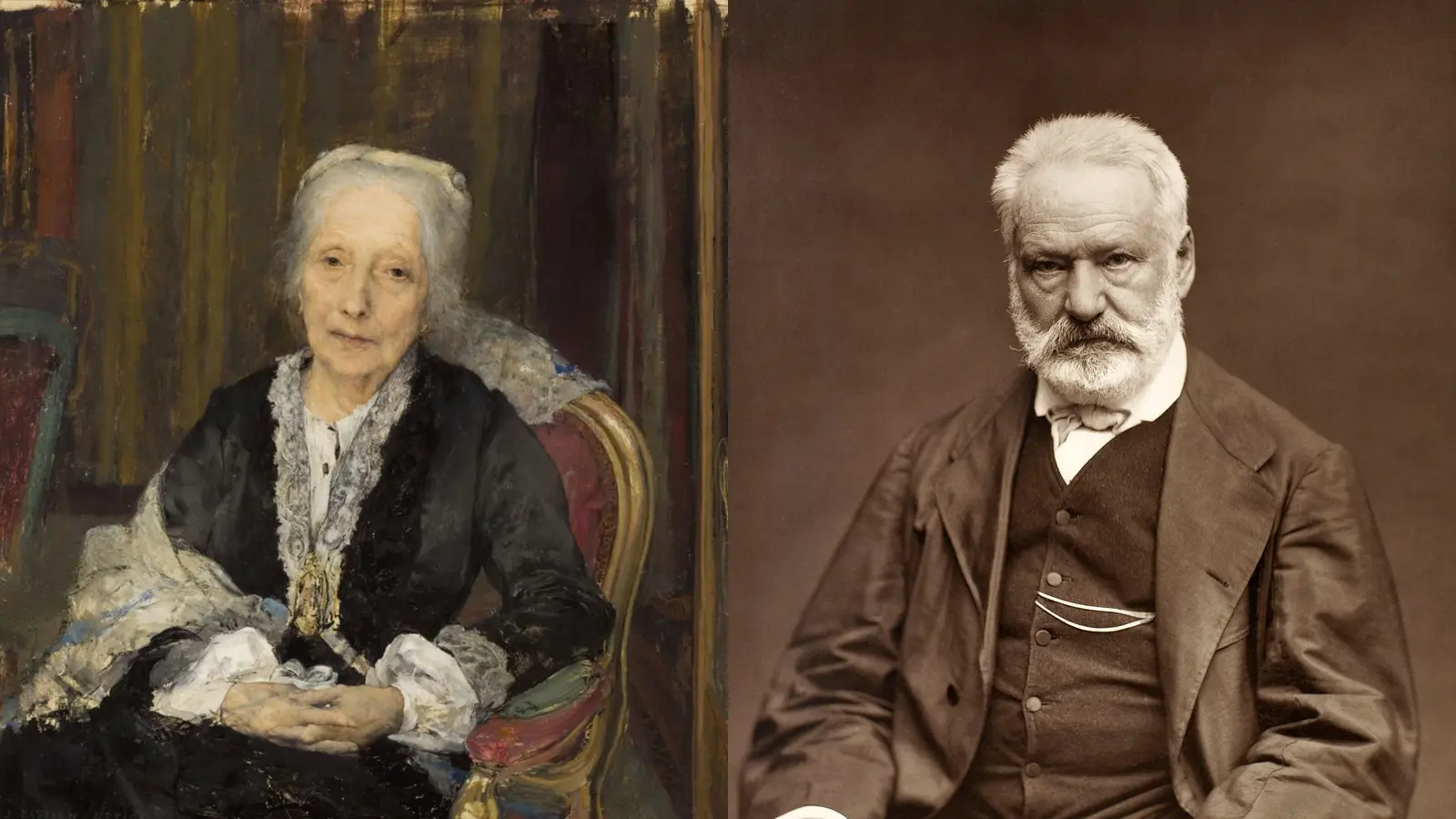
Juliette Drouet's real name was Julienne Gauvain. She was born in Fougères, in Brittany, in 1806, and she was an actress in Paris.
On January 2, 1833, she attended the reading of Lucrèce Borgia, Victor Hugo's new play, in which she had landed a very small part. Hugo was 30. He was already famous, married to Adèle Foucher, with four children.
During rehearsals, they fell in love. They spent their first night together on February 16-17, 1833.
A life almost shut away
In 1839, Juliette quit the theater. From then on, she lived almost in seclusion in her apartment: Hugo didn't allow her to go out without him. She spent her days waiting for him, and writing to him.
He also asked her to tell him every day, in writing, everything she had done.
It wasn't until April 1845 that she was allowed to go out on her own. The specialists of her letters point out that Hugo became less jealous at that point... precisely because he was being unfaithful himself.
22,000 letters in fifty years
Juliette wrote to Hugo from 1833 until her death, in 1883. Some letters are a few lines long, others run to several pages.
The letters in numbers
- 50years of letters, from 1833 to 1883
- 22,000letters, roughly
- 17,000or so, bought in 1969 by the National Library of France
- 17,647already readable online
A little over a thousand more are at the Maison de Victor Hugo, in Paris. For several years now, a team at the University of Rouen, led by Florence Naugrette, has been transcribing them one by one and putting them online.
Writing to Hugo every day, for fifty years, was her own way of saying I love you.
Claire, then Léonie
The 1840s were hard for Juliette. Her daughter Claire, born from her relationship with the sculptor James Pradier, died in 1846, at 19. Hugo led the funeral procession, with Pradier.
What she didn't know was that Hugo had had another mistress for several years: Léonie d'Aunet, a writer married to the painter Biard. There was even a scandal in the newspapers in 1845, and Juliette knew nothing about it.
In 1851, Léonie asked Hugo to leave Juliette for her. He refused. So Léonie sent her rival a package: the love letters Hugo had been writing to her for years. All at once, Juliette found out that he had been cheating on her all that time.
She didn't leave him.
December 1851: she saved his life
A few months later, on December 2, 1851, Louis-Napoléon Bonaparte seized power in a coup. Hugo opposed it, and he became a wanted man.
Juliette found him hiding places, one after another. Then she got him the clothes and passport of one of her friends, a worker named Lanvin. Under that name, Hugo crossed the border into Belgium. She joined him in Brussels.
After that, she followed him everywhere: to Jersey in August 1852, then to Guernsey at the end of 1855. Hugo lived there with his family, and Juliette not far away. In 1856, she moved into a house called La Fallue, from which she could see him on his balcony and wave to him first thing in the morning. In 1864, they bought her another house on the island, Hauteville-Fairy.
"[Juliette] m'a sauvé la vie en décembre 1851. Elle a subi pour moi l'exil. Jamais son âme n'a quitté la mienne." ([Juliette] saved my life in December 1851. She suffered exile for me. Her soul never left mine.)
Victor Hugo, instructions to his children, September 25, 1870
Until the end
Adèle, Hugo's wife, died in 1868. Two years later, in 1870, Napoleon III fell and the exile came to an end. Juliette and Victor went back to Paris.
At the end of their lives, they finally lived under the same roof, at 124 avenue Victor-Hugo, a street already named after the poet. That's where Juliette died, on May 11, 1883, of stomach cancer. She was 77.
Hugo's family and friends talked him out of going to the funeral. His friend Auguste Vacquerie gave the eulogy. Juliette was buried in Saint-Mandé, next to her daughter Claire. Victor Hugo died two years later, on May 22, 1885.
Read alsoPierre and Marie Curie: their love story, from 1894 to the PanthéonRead alsoMarie Antoinette and Fersen: their censored letters read with X-raysSources: Florence Naugrette (ed.), Lettres de Juliette Drouet à Victor Hugo, online edition, University of Rouen Normandy: introduction, biography and chronology (juliettedrouet.univ-rouen.fr, in French).
Image: Portrait of Juliette Drouet, Jules Bastien-Lepage, 1883, Maisons de Victor Hugo; Victor Hugo photographed by Étienne Carjat, 1876. Public domain.
Relationship assessment -20% right now
The complete assessment of your relationship
About a hundred specific questions on money, children, where to live, fidelity... Each of you answers on your own side, or you answer alone if the other isn't ready, and you get a full report that compares the answers, topic by topic.
- 100 questions, together or on your own
- Built on research in couple psychology
- A full PDF report, with charts
Free questions · report Usual price: €9.90 Discounted price: €7.92 for both of you